Ascension Sunday: What’s Next

3 ½ years ago, St. Mary’s was an off-beat little church at the end of the road. (Okay that’s still what we are, stay with me).  We’d been experimenting for about a decade with doing church differently:  sharing our thoughts on Scripture during sermon time, circling up to offer one another communion, always out, actively serving in the community.  But things were changing as our leaders were retiring, facing serious health problems, moving away. 

And right into this experiment trying to figure out where it was headed next, walked Sue and Bob Savereide.  We weren’t easy to figure out, but they persisted, and so did we.  With their help, we remade ourselves once again. We found new  ways to be church, children through elders, listening, crafting, learning, praying together.  And Bob and Sue became new leaders for us–Bob working on the building, Sue sharing the Sunday joy in word and photos on social media, and just generally inspiring  every family in the faith community to join in shaping our future.

And with their leadership, St. Mary’s kept growing in God’s love.  We made our worship more inclusive. We connected even more strongly to the communities outside our walls. In the Diocese of Minnesota, St. Mary’s became an example of what a thriving small church can be. 

In many ways, the folks in this funky little small-town church remind me of  Jesus’s followers: that ragtag bunch of fishermen (I’m pretty sure just about everyone not with us today is rod in hand on a lake right now.), tax collectors,  and ordinary folks dealing with loss and pain.

For about three years, those disciples traveled with Jesus,  learning as they walked. They came to see Jesus as the Messiah, the chosen One of God. And along the way, Jesus challenged everything they thought they knew about what the Messiah really was.

For example, they would have grown up with the prophecies of  Zechariah, foretelling that other nations–like Rome–would  plunder the nation of Israel. Then one day, the Lord would descend from the heavens and stand on the Mount of Olives. On that day, the mountain would split, creating a great valley surrounding the city of Jerusalem.  The enemies of God’s people would run in fear for their lives, the Lord would reside in Jerusalem, and the wealth and the people of all nations would then serve the one true God.  We see similar language in today’s Psalm, where God “subdues the people under them and the nations under his feet.”

In that time, Zechariah says,  there would also be a great equalizing where  “every cooking pot in Jerusalem and Judah” would be as holy to the Lord as the holy altar in the Jerusalem Temple. Then there would no longer be traders in the temple courtyard because sacrifice through the temple priests would no longer be required. 

At first, to the disciples, it must seem like Zechariah’s prophecy is coming true. In the week before he dies, Jesus goes with them to the Mt. of Olives and then enters Jerusalem. People wave palms, throw their cloaks in the road and shout Hosanna, Save us!  Then Jesus goes to the temples and kicks out the traders.  It looks like the moment has come.  

And then, Jesus gathers his disciple in a room. They eat a meal together, and he tells them–I am the sacrifice. And then he dies, humiliated, on a cross. 

The disciples believed they would be sitting in glory beside their Messiah,  rulers of the new kingdom, with no more Romans or temple leadership telling them what to do.  But the kingdom they’d been hoping for has come completely undone, and they are the ones hiding in fear for their lives.

When he comes back, they are amazed and joyful but still so confused.  Jesus comes and goes. Breaking bread and suddenly disappearing.  Breathing new things into their souls and leaving more questions in his wake. 

So, Lord, is NOW the time when you restore the kingdom to Israel?  they ask him, still hoping, somehow, that this, maybe, is the time that all they had been taught would come to pass.

And Jesus says, that’s not for you to know.   But you will receive power. The Holy Spirit will come upon you, and you will be my witnesses in Jerusalem, in all Judea and Samaria, and to the ends of the earth.

And then, once again turning Scripture on its head, he leads them out of Jerusalem to the Mt. of Olives.  And there, instead of God descending, appearing to save the day, the son of God mysteriously disappears, ascending like Elijah into a cloud.

I imagine the disciples standing there looking into the clouds, open-mouthed, wondering: WHAT the…?  What just happened? Now what do we do?  

What happens next is what we celebrate next week on Pentecost, one of the Big Feast Days of the church year, even though most of us in Minnesota are out fishing and completely miss it.

But the disciples aren’t there yet.  And I can relate.  I imagine you can too.  Like the disciples, I feel rooted in one spot where strange, unsettling things just keep happening, wondering what to do.

The trial of the decade has just ended.  A guilty verdict is in, and most of the world breathes relief and feels, here, justice has been done.  

But brown folks still crowd our border, escaping unjust regimes.  A young black man has shot blocks from the trial.  The verdict means a man committed to solitary confinement, probably for the rest of his life.  Jesus, echoing Isaiah, taught us to set the prisoners free.  

The pandemic is ending.   We can see the end of a brutal year of isolation, loneliness, fear, and death in sight.

But so many people remain unvaccinated. Schools keep experiencing  outbreaks. People we care about are still at risk. And suddenly, two days ago, we were told–the mandate has been lifted;  if you’re vaccinated, take your masks off, inside, outside!  And so yesterday morning, Will and I found ourselves pausing outside the Piragis Outlet, masks in hand, wondering: what to do.

And here we are,  gathering today, together, some of us in-person for the first time in over a year.   We’re outside,  practicing care for one another, happy to finally be gathered in this circle.  But those two people who walked in the door 3.5 years ago?  This first day of regathering is the day we say goodbye to them.  The sun is shining brightly, but some precious folk will soon be beyond our sight.

So what do we do next?

Well, in today’s story in Acts, just like on Easter morning, it  takes some mysterious beings in white robes to come along and say,  Men (and Women) of Galilee, why do you stand looking up toward heaven? Go to Jerusalem.

And so the disciples give themselves a shake, and they–not the Lord of Hosts–they, the confused, rag-tag disciples, make their way from the Mt. of Olives back to Jerusalem.  

Because the way Jesus tells the story, the presence of the Lord, the one coming to save us, is, actually…us.

We are the ones sent out to heal and unite the nations—the brown, the black, the white; the frightened and the scornful; the young and the old; the weak and the strong.  The church is the bearer of Christ in the world.  God isn’t going to save us without us.

But God is still, also, with us, breathing light and strength into our spirits.   And even when those we love must leave us–beloved family members, beloved friends,  beloved leaders of our church– the invisible string of love remains.  The vine still connects the branches.

As Eunice said last week, it might take four of us to do the work of one Sue or Bob.  Maybe it takes centuries and millions of us to do the work of Jesus, to slowly, baby step by baby step, bring in the kingdom.  But maybe that’s the point.  God isn’t going to save us without all of us.  All we need to do is give ourselves a shake and start walking.

Easter 6: At Home in God’s Love

The picture book Last Stop on Market Street tells the simple story of a little boy CJ and his Nana on a city bus one Sunday morning. CJ’s clearly a good little guy–he goes to church with his Nana, he gives his seat up for a blind man on the bus, and he drops the quarter he just got from the driver into the hat of the man singing for his living on the bus.  But like me, probably like all of us most days, especially these days, he’s prone to seeing the crumbling sidewalks instead of the rainbows arcing above them.  And his observations aren’t wrong: some people do have more than others; some parts of the city are rundown.  Nana, though, sees something different

CJ isn’t unlike the disciples worried in that room the night before Jesus starts on the path to the cross, desperately wanting something other than what Jesus is offering.  And like CJs Nana, Jesus, in their final hours together, tries to teach them something about joy and love, about what it means to abide or as The Message puts it, to be at home in God’s love. 

First, before he talks about love in today’s Gospel or the vine and the branches we heard about last week, Jesus does something that they don’t understand, any more than CJ understands why his Nana always has to go to the soup kitchen after church on Sundays.  He washes their feet.  And then he tells them in as many different ways as he can what the fullness of love, what happiness, what the kingdom of God looks like if only they will see as he does.  Jesus wants them to see, as First John puts it,  that God’s “commands are not burdensome, for whatever is born of God conquers the world.”

But sometimes, as CJ points out, God’s commands DO feel burdensome.  Coveting for example: it’s hard not to want what other people have when it’s a rainy day, and you have to wait to ride a bus while your friend drives off in his comfortable family car.  Or you see someone who’s got AirPods and an iPhone 10 while you’re stuck with your Mom’s hand-me-down. It can be hard to help a stranger when others just get to enjoy their day, doing whatever they want.  If you’re a disciple, I suspect it’s really hard to watch your teacher, the one you thought was going to save Israel, wash your feet like a servant and then tell you he’s going to die instead of fight for the kingdom you’ve waiting for all your life.

But through different eyes–Nana eyes–all those burdens are transformed into moments of joy.  Rain that drips down CJs nose as he waits is drink for thirsty trees.  A rickety bus and a soup kitchen are full of every kind of God’s children–so many to enjoy and love!  A blind man sees a way to make Nana’s day brighter. The music of a busker’s guitar fills the air with sunset colors and dancing butterflies.  Broken street lamps “still light up bright.” Resurrection comes from the darkest of days. As Nan says to CJ, “Sometimes when you’re surrounded by dirt, you’re a better witness for what’s beautiful.”

In the Gospel, most  translations traditionally read, “This is my command: Love one another the way I loved you.” But the Greek is probably more accurately translated this way: “This is my command in order that you may love one another the way I loved you.”

In other words, Jesus isn’t commanding us to love one another the way that he loved us or else–to go out and find a cross to die on.  Jesus is pointing his disciples back to all he has said and done while they’ve been together, summed up in the command to wash one another’s feet. Do what I do, he says: follow my example, just as I follow my Father’s way of love. Appreciate others’ gifts rather than coveting what they have. Forgive people and show mercy just as God does. Serve others in the simplest ways. Because if you do, Jesus says, there you will find the joy that comes from loving one another the same way God loves you. 

As Nana’s gentle, persistent example shows CJ,  serving God is not centered on hardship, self-denial, and sacrifice.. It’s friendship and deep laughter. It is finding beautiful where no one else thinks to look. It is the delight of giving to others. It is living at home in God’s joy-filled, abiding love.

Easter 4: Wolves and Sheep

When my son Cole was 3 or 4, he threw tantrums at dinner on the regular. Our usually easygoing kid would blow his top over the most minor things and turn our family meal into chaos.  

Over and over, I’d him up and carry him to his room for a time-out, telling him he could come out when he calmed down.  Because in his fury, he was usually way too angry to actually stay in his room just because I told him to,  I’d often stand outside the door, holding it shut while he banged furiously, getting himself angrier and angrier until he wasn’t so much calmed down as wiped out.  Then we’d both head back downstairs to recoup what we could of failed family time.

These episodes weren’t my finest moment as a parent, but it took me a long time to realize it.  I think it was the book How to Really Love Your Child by Ross Campbell that finally prodded me into seeing what I was doing wrong. I didn’t agree with everything in the book, but one important piece that stuck with me was the importance of “filling your child’s love tank” every day. When a child acts out, Campbell said, consider first: Have I shown them my love today, through both physical touch and my active love and attention? Added to that, I remembered the commonsense questions the parents in ECFE  and the moms in La Leche League would ask each other whenever one of our littles was acting up:  Is he hungry?  Was she tired?  Fill that tank with food, rest, attention, and love, and 90 percent of the time, the problem will go away.  

As I thought about Cole’s tantrums, it suddenly became glaringly obvious: by six o’clock at night, especially with the limits I was putting on before meal snacks, he was past hungry. Having outgrown naps and after a busy day playing with the kids in my home daycare, he was almost always exhausted.  This, I reminded myself, was the child who would fall asleep at 4:30 and sleep through to the following morning.  So we adjusted meal time and loosened up on snacks–and the tantrums disappeared.

Twenty years later, I still think  about putting Cole through those traumatic timeouts though he’s long forgotten them.  This week, as I thought about the  Good Shepherd, the hired hand, and  the Godly Play question, “Who do you think you might be in the story?” I think I finally understood why that story has stayed with me for so long.  

The Godly Play Good Shepherd story combines Jesus’ parable with psalm 23. The Good Shepherd knows his sheep, and his sheep know him.  He provides them with food, water, and rest and protects them even in the darkest places.  The wolf, on the other hand, “scatters” and ‘snatches” the sheep, and the hired hand just gives up and runs off when things get tough.  

As I dealt with my tantrumming preschooler, I was the wolf in the story.  My sister once told me how my niece in her first weeks of kindergarten would throw herself to the ground in a full-on tantrum the minute she stepped off the school bus and saw her mom who, understanding her daughter’s pent-up emotions, just said, “You go girl.  Get it OUT!”  On the other hand, I snatched my hungry and tired boy away from the security of the family table where he was trusting us enough to let himself go. I scattered our comforting family circle, sending him off into exile that his exhausted body and mind could not understand.  

And today, when once or twice a year, I lose my temper with an upset, struggling student when my patience is spent, or when I watch videos of police officers barking orders at frightened drivers pulled over for minor offenses,  I see that same wolf.  Today’s letter from John asks, “How does God’s love abide in anyone who has the world’s goods and sees a brother or sister in need and yet refuses help?”  That moment where it feels more important to control than to help one another is not a place where we live in  God’s love.

That said,  even though I need to be working continually to be more like the Good Shepherd and less like a wolf or hired hand, I’m glad that in this Godly Play story, I can also be one of the sheep. 

Psalm 23 describes our life in Christ is a journey, sheep with our shepherd.  As God’s people, we experience times of rest, where we are fed, and our thirsts are quenched.  We go through valleys of darkness.  This year has for sure been a mixture of all those things.  Throughout that journey, as John’s letter puts it, we try to do what pleases the One who is “greater than our hearts…and knows everything,” following his voice and abiding in his love by loving one another “just as he has commanded us.”    But we never stop going through those valleys and straying from the proper path.   

Through it all, though, there is the Good Shepherd: using his staff to guide us and his rod to prod us; calling us by name; setting a table that provides what we need for our most challenging encounters with others.  Notice the way Psalm 23 sets grassy meadows beside darkest valleys; blessings of oil in the presence of enemies.  In the parable, the Good Shepherd lays down his life where the careless hired hand runs from danger; the wolf scatters as the shepherd gathers; the sheep listen, and they stray.  In the original wording of Psalm 23, goodness and mercy don’t follow us all the days of our lives; they pursue us.  And we don’t dwell in the house of the Lord forever; a closer interpretation of the Greek is that we return to it.  Straying off the path is part of our human journey, but so is the enduring love of that Shepherd who never stops finding us wherever we are.

So if my actions toward my son were wolfish for a month or so, I think what mattered most in the end was the way that the Good Shepherd pursued me and prodded me to return to the right path, where I remembered to listen to the small, tired, ornery  sheep in my particular sheepfold.  And so may we all, not in impatient “word or speech,” but in resolute “truth and action,” fill one another’s love tanks. 

Easter 3: What We Will Be

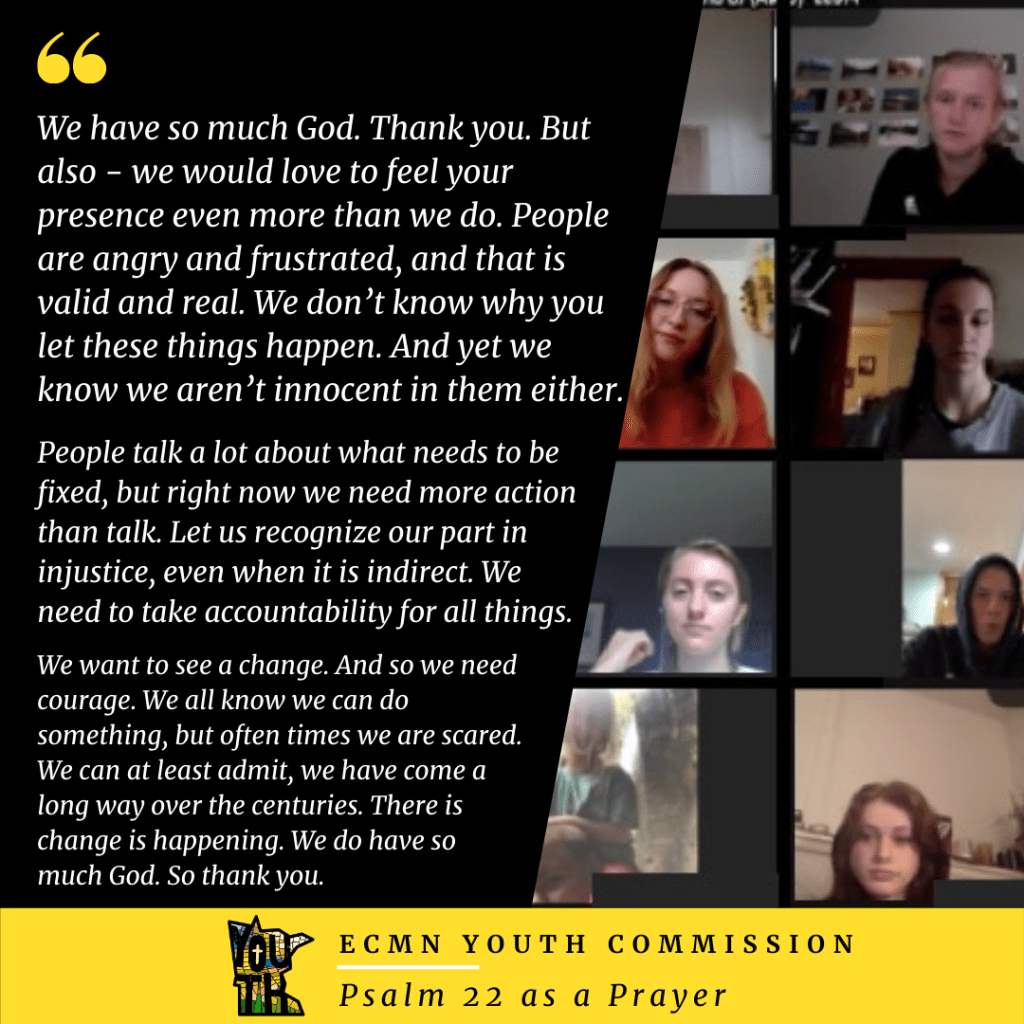
These lines from this prayer written this past week by our ECMN Youth Commission (including two St. Mary’s teens!), have stayed with me all week: “Let us recognize our part in injustice, even when it is indirect. We need to take accountability for all things.” If we are lucky, our youth will be the future hands and feet and voices of Jesus in the future.  This reflection is my attempt to listen to their voices.

Most of you know, because of my major gloat during the NCAA, tournament two years ago (Wahoowa!), that I spent four happy years as an undergraduate at the University of Virginia.  One of the few things I disliked about my time there was how segregated the college was.  After first year, most of us lived, studied, and hung out with people whose skin color was similar to our own. Our social life, in particular, revolved around the fraternities and sororities that were, with rare exception, separated by lines of color. And, it seemed to me then, students of color were so often in the news, complaining about injustices that I thought were exaggerated.  I didn’t get why it had to be that way.

Some of us–mostly well-meaning white students–decided to create a group called STARS–Students Together Against Racial Separatism–to come together to discuss the invisible line dividing the Grounds by color and to try to eradicate it.  I remember going to the first meeting full of excitement and hope, especially when I saw the diverse group who had gathered for the meeting.  The leaders outlined their vision.  And then a black student in the crowd stood up.  This was 35 years ago, but here’s the gist of what I remember her saying, mostly to the white students gathered there.

“Look. You don’t get it.  This isn’t about you.  We like to be together.  For some of us, this is the first time in our lives we’ve been able to support one another, to talk about things that have happened to us. There’s nothing wrong with that.  We know you want everyone to get together and be one big happy family, but it’s not that easy for us.”

I was blown away by this.  From my comfortable worldview, everyone getting together, seeing each other on equal terms,  and just getting along was exactly what needed to happen!  But when that honest and patient young black woman and the others that followed her got up and told us their truth, it helped me begin (just begin!) to understand that my experience and my vision of the world was neither universal nor the ideal. 

It took many more blunders like that to make me understand that just believing that skin color didn’t matter and just making personal decisions that demonstrated I wasn’t racist didn’t make me or my experience the same as my black classmates and friends. Black students who crossed those same lines often found themselves in unsafe, unfriendly, and sometimes dangerous territory.   I wasn’t wrong that we are all equally God’s beloved children, but bringing that kingdom to earth was going to take something more from me. And the first step for me was to take my blinders off and see.  

This is, I think, something like what Peter is trying to do in today’s reading from the Acts of the Apostles.  When I hear “You Israelites,”  followed by a lecture on all the terrible stuff they did, killing the AUTHOR OF LIFE, my first impulse is to cringe and dismiss the whole passage as an anti-Jewish rant.  Except that Peter is Jewish, and he’s speaking to his own people, trying to make them see how their comforting belief in a Messiah who was going to rescue them from the Romans, restore the throne of David, and bring a happy ending to all their troubles was not just off; it actually hurt–killed–an innocent man, a holy man, who had done nothing but tell them the truth about themselves and about what really needed to happen for the kingdom of God to appear.  

In his book My Grandmother’s Hands, retold on On Being, trauma therapist Resmaa Menakem describes a day when he was a child, sitting on the couch with his grandmother watching the Milwaukee Bucks, who his grandmother loved.  She was sitting as always on the couch with her legs draped across the children’s legs and her arthritic hands on her thighs, and the kids would rub them, as they all sat together and watched the game. 

One day Resmaa looked at his grandmother’s hands while he was rubbing them and blurted out, the way kids do, “Grandma, why your hands so fat?” And without missing a beat — not even taking her eyes off the game she said, “Oh, boy, that’s from picking cotton.”

He just sat there for a minute and then said, “From picking cotton?” 

Something in his tone, he explains, must have caught her attention because she looked at him and said, “’Boy, you ever seen a cotton plant?…. Them damn cotton plants got a burr in ‘em…. I started walking up and down them rows when I was four years old….As you walking up and down the rows, you put your hands in, them cotton plants rip your hands up. And so when they rip your hands up, your hands bleed.’” 

Then she turned back and started watching the game again. But something in her voice caught Resmaa, and even as a little boy, he knew he had to pay attention to it.  Looking back on that day now as an adult, here’s what he has to say:  “Einstein said energy cannot be created nor destroyed. But it can be thwarted. It can be manipulated. It can be moved around. When we’re talking about trauma, when we’re talking about historical trauma, intergenerational trauma, persistent institutional trauma — and personal traumas — those things, when they are left constricted, you begin to be shaped around the constriction….So when my grandmother is saying that, I need to pay attention.” That day, his grandmother’s story, carried in the hands he rubbed, came alive to him and changed the way he saw her, himself, and the world.

It may be that Peter’s Israelites have trouble seeing Jesus for who he is because the trauma that they have experienced–the trauma passed down through their yearly Passover remembrance of their delivery from slavery and reimposed on them by the Roman occupation–makes it extraordinarily difficult for them to accept that the Messiah they had hoped for is this man who allied himself with the weak, the sinners, and the aliens, this man who gave up without a fight to a brutal death on the cross.  The story of the Messiah who suffers–although it’s as deeply embedded in Scripture as the victories of King David–is not the story they had been telling themselves all their lives.  It’s not the story they wanted.

This may be the same trouble faced by the two disciples on the road to Emmaus in today’s Gospel.  When Jesus first appears, “their eyes were prevented from seeing him”;  instead of Jesus doing the preventing there, it makes much more sense that the trauma that keeps them clinging to their hope in one who would redeem the human kingdom of Israel is what keeps them from recognizing Jesus.  Jesus keeps pressing the disciples to see and touch the wounds on his hands and feet because he wants them to stop grasping for a God who will reward His people with earthly power and riches and instead accept the one who redeems the suffering of this world by entering into it.  Like Resmaa, touching those scarred hands may be what is needed to make the disciples feel the reality of Jesus’s woundedness, the woundedness of their community, the woundedness within themselves, the woundedness of the world.  

And so it is with me and maybe with you, still reluctant to let go of the comfortable narratives we create to solve the same problems we faced decades ago.  Our own woundedness and fear can still, as Peter puts it, cause us to act in ignorance and keep us from seeing other’s struggles and other’s truths. But here’s what I know: when we do start, like the disciples, to let that fear go, there is the love and the glory, the presence of Christ, right there, breaking bread and eating with us, forgiving, opening our minds, blessing us with the peace that comes from seeing what is true–which is not always what we have wished to be true.    When God’s children finally come close and touch one another’s pierced and swollen hands, feeling the pain of all God’s beloved, then, to riff off John’s Letter, finally, what we will be, will begin to be revealed.

Easter Day: Seedlings All Around

Very truly, I tell you, unless a grain of wheat falls into the earth and dies, it remains just a single grain; but if it dies, it bears much fruit.  John 12:24

Today’s version of the Easter story from Mark is one we rarely hear.  The earliest of the Gospels, it tells a story that unsettles and disturbs us, one we look to the other Gospels to finish for us more happily.  And yet, there is something about this Gospel that feels real. When the women come to the tomb to anoint the body of Jesus in Mary and find that he is gone–with a strange man in white telling them he was “raised”–they have no way to understand that.  For them, as for us, death is simply the absence of life, a time of mourning and loss.  Lightning had struck the great oak tree they had come to depend on for shelter and strength; their teacher, their friend, had died on a cross. So when the strange man in the tomb gives the women a message for the disciples and Peter, they run from the tomb in amazement and terror, and, according to this Gospel, they say nothing to anyone. And who could blame them, really?  There is no life in death. None of this makes sense. 

Except…everything in the natural world and everything that Jesus taught them says otherwise.

In the forest, the dead tree in A Log’s Life gives life to many, from lichens to fungi, from gorgeous woodpeckers to prickly porcupines and even to slimy slugs.  When I was in college, I was great at the Atari arcade game Centipede; I could play for over an hour on one quarter, and my initials stayed on the high scorers’ list on my favorite machine. Mostly I loved the game because centipedes, with their creepy legs and armored, snaky bodies, seemed so worthy of extermination. When the game Millipede came along, it was too much ick even to play.  And yet the log gives even millipedes food to live.  

And so it was for Jesus.  In his life, he welcomes everyone–the lepers, the slimy tax collectors, the rich, the poor.  And when he dies, that welcome just gets bigger. He summons the disciples and Peter–Peter, the loyal friend who swore he’d stand by his side and then in fear for his own life, denied he knew him.  Yet Jesus summons  Peter by name to Galilee, where  Peter tells us in Acts,  Jesus–the one who was killed, hanging from a tree–gives them food.

And then Jesus leaves again.  But again, not really.  In that rich soil of his example, his rising, his love, his followers are, like the acorn, given life.  Their terror leaves them, and as Peter tells us,  they spread the good news as a young oak tree spreads its leafy branches. And, again, from death comes life.

Living through this past year has, in many ways, felt a lot like being struck by lightning.  As we gathered a year ago, we were afraid.  An unstoppable virus was spreading sickness and death.  The familiar, everyday places where we worked and ate and played and learned and worshipped shut down as we sheltered in place, unsure how to stay safe.   And then another man died a confusing, violent, and senseless death, and protests erupted in our state and then around the country.  We were cracked open, broken, and bruised. So many structures we thought of as sturdy and immovable shelter were broken, our assumptions of how things should be scattered like the limbs of the oak tree.  

And then, as time passed, we realized that toppled and split, the tree was still there. Messier than before, with lots of parts missing, there still lay the trunk and the roots.  Our families, our faith community, our closest friends, still feeding and sheltering us.  We learned new ways to live our daily lives, to learn, to work, to connect.  

And over time, some of the stuff that we thought was so essential began to break down, transforming into something new. We discovered new ways to see and care for one another–from wearing a mask to recognizing the biases we never knew we had.  Like the women at the tomb, we started to see that death is loss and death is frightening and death is hard–but the death of what was sometimes also creates space for new life. 

And so, here we are, another Easter on Zoom not spent getting doused in water by people half our size, not hunting for Easter eggs, not sharing a feast of ham and braided bread and fruit salad and way more jelly beans and chocolate eggs than are good for us.  Sometimes it seems like that stuff will take as long as it takes an oak seedling to grow into a tree to happen again.  And yet, everywhere, within us and around us, so many new seedlings–new ways of understanding and seeing and caring, new ways of being God’s loving presence in the world–are rising out of the soil of our lives.  What does that new life look like in and around you?

Lent 4: The Serpent’s Bite

By Holger Krisp – Own work, CC BY 3.0, https://commons.wikimedia.org/w/index.php?curid=17570143

I love this week’s weird little story about Moses raising the bronze serpent in the desert, with the people gazing on that image of the venom coursing through their own veins to live.  Those grumbling, never-happy Israelites: they are My People.  I’m right with them more often than not, lost in the desert, complaining about everyone and everything making my life a mess, right up until my venomous self bites me back.  

For example, just this week, I was ticked off at my college composition class because none of them turned in their essays on the due date. I stress deadlines because I need to get papers graded on a schedule; they’re messing with my week, I fumed.  And then, checking online one more time—just to really stew about how Not Even One—I realized that I had never opened the paper dropbox.

So we all make mistakes.  And my first thought was –shoot, I better fix that and let them know I forgot so that they can get those papers in.  But my next thought was, Well, I’m not going to apologize!  They are supposed to be responsible! One of them should have emailed me to tell me. Staying in touch with your teacher is what a good student does! They need to learn that! In the moment, that actually felt like sound teacher logic instead of what it was: self-justification, a stab at putting my embarrassment at my mistake, my own lack of responsibility, off on someone else–or in my case, a dozen someone elses.   In other words, “There’s no food! Oh wait, there’s manna.  But that food is terrible!  Your fault.” 

I usually catch myself before I inflict my venomous thoughts on my students, but there have been times when the serpent bit, and the poison went deeper.  A friend didn’t call or excluded me from an invite or hurt me in some other way, and I let that hurt fester in my veins. Eventually, I’d ask God for help, which didn’t immediately stop the poison so much as help me step out of myself to observe the serpent at work inside, to see what was really biting me—my own poisonous imagination. This didn’t always completely heal the hurt, but it kept the poison from spreading. Over the years, too, I’ve learned that the explanations I come up with for others’ actions are nearly always wrong.  That people are complicated and never what my fear and insecurity project onto them.

All of this brings me to today’s Gospel.  `Jesus tells his followers that the Son of Man will be lifted up just like Moses lifted the serpent in the desert so that they will live.  And as we who hear the story of Christ’s Passion every year know, by the end of the story, everyone—the Roman occupiers, the religious authorities, those who flocked to see him, and his closest friends — are all part of why that happens, why Jesus ends up on that cross.

Too often, we think of sin and salvation as some kind of Galactic opposition:  Darth Vader vs. Luke Skywalker; evil versus good Republican vs. Democrat; dark versus light; Christian vs. Muslim; condemned vs. saved; Pharisee versus disciple.  But it seems to me that sin, actually, is just every day choosing to see icky white sap in the sand where we could see manna, our daily bread; choosing not to acknowledge our own mistakes and put them right; taking our fears and insecurities and putting them on someone else to carry. 

This past Friday’s Virtual Prayer Tent, Healing our City, where people are praying each morning throughout Derek Chauvin’s trial, featured a young ministry student, Menzi Mkambule, from the  Kingdom of Eswatini in southern Africa.  After offering a Lament of Racism in the U.S. and the world, Menzi reflected on two words from his language:  sawubona—I see you—and ubuntu—I am, because you are. 

Menzi’s explanation of ubuntu and sawubona helps me understand how the mental gymnastics I go through blaming other people for my own stuff can, in Jesus’ words, keep me from the light.  All of that self-righteousness keeps me from seeing others as God’s beloved children, and thus from the work of the kingdom. As Paul tells us in today’s second lesson, “For we are what he has made us, created in Christ Jesus for good works, which God prepared beforehand to be our way of life.”  In other words, we don’t do good works to be saved or to prove we are better than those sinners over there who need our help: we act justly and kindly because of ubuntu; because in God’s kingdom, I am, only because you are

This is the heart of the work of racial reconciliation and of all the work we are called to do as Christians.  Our work is not to condemn one another—to name some people as righteous and others as evil.  According to Menzi, ubuntu is about recognizing God’s image in everyone and then advocating for one another.  I am because you are: invited by the Spirit to see you, to hear your stories, and to choose loving relationship; invited to let all of the poisonous fears, comparisons and self-doubts that drive me to protect my own power and to put my own missteps on others’ shoulders dissolve; invited to shed that serpent’s skin and live.  

Lent 3: Hidden Treasure

Last week, I kicked one of my students out of class.  The student had been failing because he wasn’t doing the work, wasn’t paying attention in class—for reasons that neither of us could figure out.  On that day, full of frustration, he was sitting in the back of the room before class started, holding on to a handout I had asked him to revise, loudly telling whoever was on the other end of the line that he was failing because his teacher wouldn’t take his work.  Even after he hung up, he kept repeating, loudly, that I wouldn’t accept his work, so he was failing, on and on, until in complete exasperation I said his name—also loudly and sharply—and told him to leave class.

In many ways, I was justified in doing this.  Class was about to start; he was disruptive; what he was saying was incorrect; he wasn’t in the mood to listen.  But as I curtly told him to leave for all those reasons, there were things I wasn’t thinking about.   I didn’t think about the scared, angry young man whose tangled brain was shooting all of his stress wildly out of his mouth.  I didn’t try to repair the rift.  I could have said, “I’m happy to have you in class  if you’re ready to learn, and we can talk about how to get your work in after we’re through” I could have said, “I need you to leave now, but you’re welcome to come back to class tomorrow and to talk to me later today about that work.” The heart of teaching for me comes from trying to help students–no matter how much they struggle or how they are doing in any given moment–on a path forward toward seeing themselves as writers, as learners, as as capable of success as anyone else in the classroom. That’s what gets me up every morning. Yet, in my exasperation and frustration, I forgot why I teach and, in the process, severed an already tenuous relationship.  I chose my rules, my need to feel in control, my walls, over connection.

Today’s lessons explore the gifts and the perils of rules.  Psalm 19  opens by describing the beautiful orderliness of creation.   In the translation from The Message that we read in church today, Madame Day holds classes every morning, and Professor Night lectures each evening; the unspoken truth of their words is everywhere.  The warmth and light of the sun and all creation are clear signposts showing the way to joy and life in God’s kingdom. It’s out of that unspoken created order that the spoken word of the law springs, its purpose not to constrain or limit us but to warn us of danger and direct us to hidden treasure. The law of God is a way to capture and express the gifts of God that are everywhere, giving us the eyes to see.

Reading the detailed Covenant God makes with Moses (which begins with what what we now call the Ten Commandments) through that lens is a game changer for this girl, who was brought up to memorize and obey those commandments because they were The Rules. But look how God begins the Covenant:  I am the Lord your God, who brought you out of the land of Egypt, out of the house of slavery.  Logically then, what follows is not a list of rules imposed upon us by an even more powerful despot, God, so much as a description of what we are now free to do as beloved participants in His kingdom. As Godly Play puts it, they offer the Best Ways to Live in the company of YHWH, the One who created us in His image and desires nothing, really, but a loving relationship with us.  But then, the people took the story of how to live in freedom, inscribed it on tablets and locked it away in an ark, hidden in a tent for holy men to guard. And so it goes to this day as we post those rules in stone outside courthouses and framed on the walls of Sunday school classroom, periodically reciting them during the Penitential service in church as we did this morning. And sometimes, too, we use them less as guideposts for our journey and more as ways to judge and to set ourselves apart from others who are not like us.

Later, as laid out in other parts of the Mosaic Covenant, great temples were built to house the Law. Walls were built that kept people in their proper places:  a wall between the Gentiles and the Jews: between the men and the women, between the ordinary folk and the priests.  And deep in the temple was a special space for YHWH to reside, a place that no one could go except the holiest of the priests, once a year.

The people also made sacrifices to YHWH at the temple, just as their ancestors had before them, but following a different and very specific set of rules.  For example, people would sell their own animals to buy the correct sacrificial animals at the temple. To purchase those animals, they’d need to exchange their local money for the money accepted at the temple.  Then they’d present the animal to the temple priests to sacrifice to YHWH in order to atone for their sins and bring them into right relationship with God. This, too, was part of the Covenant, though over the years the Prophets also taught that the superficiality of much sacrifice was not pleasing to God, who was pleased instead by contrite hearts, kindness toward others and a love of justice.

It is within that prophetic tradition that Jesus in John’s Gospel enters the temple at the beginning of his ministry. When he drives the moneylenders, the animals, and their sellers out of the temple, overturning tables and telling them, “Stop making my father’s house a marketplace,” he’s recalling the words of the prophet Zechariah, whose book ends: And there shall no longer be traders in the house of the Lord of hosts on that day.” Jesus the Messiah is working to break down walls that the people over time have set between themselves and God; to help them see that God is not hidden in a tiny room in the temple or high in the sky savoring the scent of their sacrifice.  God is right there with them in His house.  God is, in fact, right in front of them.

The Gospel of John was written after the Romans destroyed the Second Temple, and so it also says to those who lived in those times and to us today: it’s not the temple or even the law that ties you to God. The God who has been with you from the beginning is also this Messiah in the temple, torn down and risen again and with you, wherever and whoever you are.  Present with me and with every one of you on Zoom today.  Present with those who aren’t in a house of worship this weekend. Present with the student I so abruptly kicked out of class this week. 

The question is whether I will choose to keep Jesus safely behind church doors, following rules to be reassured that at least I’m not so bad as those who don’t follow them. Or whether I’m willing to take on a risk and a far greater challenge: to walk each day with eyes open in the light of the Love that shines on everything and everyone, listening to the voice of the God who is the unspoken truth that fills the earth.

Lent 2: What We Carry

Parables are stories told to help us see in a new way, to help us get at mysteries that defy simple explanations.  In Godly Play, we describe them as gold boxes with lids that we reopen again, each time finding a new way into God’s deep, endless and unfathomable gifts.  Jesus’ parables are treasures of our faith tradition, but others tell them as well. One of my favorites is a  Zen Buddhist parable about two monks walking down a road.  This version is from the beautiful Caldecott honor picture book Zen Shorts by John Muth.

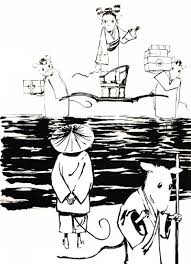
Two traveling monks reached a town where there was a young woman waiting to step out of her sedan chair. The rains had made deep puddles and she couldn’t step across without spoiling her silken robes. She stood there, looking very cross and impatient. She was scolding her attendants. They had nowhere to place the packages they held for her, so they couldn’t help her across the puddle. 

The younger monk noticed the woman, said nothing and walked by. The older monk quickly picked her up and put her on his back, transported her across the water, and put her down on the other side. She didn’t thank the older monk, she just shoved him out of the way and departed. 

As they continued on their way, the young monk was brooding and preoccupied. After several hours, unable to hold his silence, he spoke out. “That woman back there was very selfish and rude, but you picked her up on your back and carried her! Then she didn’t even thank you!” 

“I set the woman down hours ago,” the older monk replied. “Why are you still carrying her?”

This week, as I read through the lectionary readings, those two monks and that arrogant woman kept popping into my mind, making me re-see and rethink some familiar and difficult biblical texts, just as I think God and Jesus might be trying to push Abram and Peter in those passages to new ways of thinking and seeing.

In the Genesis story, God promises Abram and Sarai that they will give rise to nations.  This is the story we saw unfold this summer in Godly Play. These are the same words God said to Abram and Sarai at the very beginning of their journeys; they are the original blessing and promise that sent them on their way.  Since then, they’ve traveled from Ur to Haran to Egypt and back again, and throughout all of those years, Sarai remained childless.  Like the younger monk in the Zen parable, Sarai’s head is now filled with bitterness and fear over the injustice of the situation. Finally, she decides to take matters into their own hands; Sarai gave her slave Hagar to Abram to beget a child through her slave.  You’ll all remember what a mess that created!  It is right after that piece of the narrative that this passage begins.

What’s most striking here is what God doesn’t say.  He doesn’t get angry because they lost faith in his promise and tried their own fix.  He doesn’t point out how they’ve made things worse for both Sarai and Hagar.  True to the promise he made to Noah, he also doesn’t go back on his covenant. Instead, he repeats it:  Abram, you will be the parent of nations, and so will Sarai.  And then, strangely and without explanation, he gives two people in their late 90s new names–and with those names, new identities, new futures, new ways of seeing.  

I wonder if it’s the realization of what chaos he’s created by not trusting in the covenant that makes Abram fall on his face before the Lord in this passage.  What we know is that he rises with a new name, a new hope, and soon the birth of a new son.  And God blesses it all, creating nations of kings from both sons, the son born from their doubts, anger, and fear and the son of their new identity.

This week’s Gospel opens with Peter– like the younger monk, feeling all the injustices of power, which he expects his teacher, the one he has just named the Messiah, to correct.  Jesus rebukes this thought though far less gently than the older monk.  Their point is the same, though:  full of righteous indignation, the younger monk and Peter are losing their way .  Jesus sees the injustices around him and his disciples just as clearly as Peter does–he spends all his time healing those most hurt by it, fearlessly calling out the authorities.  But God’s way is not to seize human power.  Like the way of the elder month, who picks up the woman so full of the arrogance that comes with wealth and power–God’s way is to pick up the cross, that terrible and shameful instrument of torture used by the Roman rulers to keep conquered people in check.  Jesus carries the cross for and with all of God’s beloved who suffer under its weight.  And then, echoing and fulfilling the ancient covenants, his death death mysteriously and wonderfully transforms that pain into a symbol of rebirth and new life.

The final twist in today’s lectionary comes from the psalm.  On the surface, this excerpt from Psalm 22 is a straightforward reminder that Gold listens to the poor and to everyone who cries out to him.  But that simple, comforting message comes right at the end of the psalm that we know best because we recite it solemnly on Good Friday. It is the psalm that begins,  “My God, my God, why have you abandoned me?”: the words that Jesus–the Messiah, the elder monk, the steady follower of God’s way–says on the cross.  And so Jesus joins our own angry, frustrated, abandoned younger monk voices even in anguished lament. 

And so also, back and forth we go, with Abram and Sarai, with Peter and the psalmist, ricocheting from older monk to younger monk: one day, gladly following the One who loves and cares for us; the next, succumbing to those angry voices in our heads too frustrated to see the way forward. And every day, through the promises of the Covenant, through Jesus, who enters so deeply into solidarity with all of who we are, God takes it all, loves it all, transforms it all into blessing and new life.

Lent 1: No More Floods

Noah and the Ark is such an extraordinarily difficult story.  On the surface, it’s the story you most want to tell children–two of every animal and a happy family caring for them in a cozy ark rocking on the waves, ending with dry land and a rainbow promise.  And yet every child sees straight through that story almost as soon as they can talk.  Why do all the people die?  What about the children?  What about the baby zebras?  Why was God mad at the baby zebras?  And no honest adult knows how to answer those questions, because they are ours too.

The ark story is one of the oldest that we tell in the Judeo-Christian tradition, and has roots that reach even deeper and wider.  From the Ancient Mesopotamians to the Ojibwe people of our own Northwoods, each culture seems to have its own version of a great flood story. Without a modern understanding of science and geography, assigning natural events like floods to the gods was natural. So to those who first told the story, asking why God made the flood wouldn’t even be a question; what or who else could make it?

Even though our understanding of why that ancient flood happened has grown over the years, the story continues to resonate because floods still happen.  People, homes, animals, trees–all of the created order in a particular place and time–are still, suddenly and catastrophically, washed away.  Even when we control waters with dikes and dams and canals, filling in bays and streams with gravel, soil and cement, the waters are never fully tamed and still sometimes break through whatever we use to contain them.  Sometimes the flood comes in other forms too.  As a storm surge that washes out Duluth’s shoreline. As a blanket of frozen water that shuts down Texas.  As wave after wave of animosity faced by brown and black people just trying to live their ordinary lives. As a pandemic that surges through the world. 

The flood story of the Bible is different from other flood stories, but not because of how the Bible says it happened.  This story is different because of what happens next.  In this story, God reaches out to Noah and makes a promise, a solemn, binding covenant:  no more floods that destroy everything. No matter what happens, no matter what we deserve, no matter what we do right or wrong, God says:  I choose relationship; I choose blessing; I choose life.  In an ancient story, within a larger world populated by gods who treated humans like toys, that was revolutionary.  And in our world, where we’d rather focus on who’s to blame for whatever bad thing just happened, choosing relationship, choosing to love and cherish others no matter what  is still revolutionary.

Still, it’s natural that we all–children and adults alike–ask why when bad or scary things happen.   And it’s natural as well that the adult in the room, looking at that frightened child, struggles for an answer. Suffering is real. Sometimes suffering is a leftover of decisions made long before we were born.    Sometimes suffering just happens.  And yeah, sometimes, we are responsible for others’ suffering.  But no matter what the circumstance, looking into the eyes of that child,  a loving adult will nearly always say something like this:

I’m so sad and sorry that happened.  I know you are scared and hurt. But I promise: it’s going to be alright.  I will take care of you.  I promise that no matter what happens, I will keep you safe.

We say those words, knowing that we can’t always keep the people we love protected from all of the ways that the world will hurt them–or even the ways that we might hurt them sometimes.  But here’s the other thing we know.  Our love will, through it all, keep them safe.   

We know this because we’ve experienced the love of our Creator who covenanted with our ancestors before time was even counted, who promised that no matter how bad things get, that nothing will ever destroy us because we are God’s  beloved creation.  We know this because, over and over, hands and prayers and hugs and meals and doggy kisses and sun shining through the trees–the beauty and love of God’s beloved creations all around us–keep us safe.  And we know this because, like Jesus in today’s Gospel, it’s when we are at our limit, parched with thirst, that we most clearly know the angels who wait on us.  

Catastrophic floods have come and gone thousands of times since the time of Noah.  People, animals, the natural world experience devastating loss.  Suffering happens no matter how strong our faith.  God does not promise otherwise.  But God does promise–God solemnly covenants: you will endure; I will bless you; I will not forget you. And because a covenant is a two-sided promise, God expects that we will do our part.  When the flood washes over others, we also promise:  I am with you. I see your hurt. I will do my best to keep you safe.   That, God’s beloved,  is the answer, the promise, and the way of Love. 

The Last Sunday After Epiphany: Climbing Mountains

This is Transfiguration Sunday, when Jesus climbs a mountain with his closest friend and is suffused with light.  Always before, as I’ve read this lesson,  I’ve been caught up in the glow of that moment.  This year, though, it is the mountain itself that captured me: both the climb and the view from the top.  And all week, I kept seeing and hearing mountaintop stories.  I’ll tell you a few of them, and as I do, see if they spark a few of your own.

The First Story

As most of you know, Mt. Everest–the world’s highest mountain above sea level,  has for many decades been seen as the ultimate mountain top for experienced climbers to summit. Many spend years and many thousands of dollars to prepare for the experience.  In recent years, though, thousands of inexperienced climbers have attempted the climb, backed by agencies happy to cash in on their inexperience.  

In the spring of 2019, experienced climber Fatima Deryan described her experience on Everest’s summit.  One hundred fifty people packed together, clipped to the same safety line. Inexperienced hikers collapsed in front of her from lack of oxygen and water. 

“A lot of people were panicking, worrying about themselves — and nobody thinks about those who are collapsing,” Ms. Deryan said.

“It is a question of ethics,” she said. “We are all on oxygen. You figure out that if you help, you are going to die.”

She offered to help some of the sick people, she said, but then calculated she was beginning to endanger herself and kept going to the summit…. On the way back down, she had to fight her way again through the crowds.

“It was terrible,” she said.

https://www.nytimes.com/2019/05/26/world/asia/mount-everest-deaths.html

The Second Story

 One evening at the end of January in 1956, segregationists opposing the successful Montgomery boycott threw a stick of dynamite onto the porch of the Rev. Martin Luther King while his wife, daughter, and a friend were inside.  Dr. King came home 15 minutes later to find an angry, partially armed crowd of supporters gathered in front of his house, refusing police orders to disperse.  Holding up his hand, he calmed them down and sent them home with these words:

“ I want you to love our enemies. Be good to them. Love them and let them know you love them….. I want it to be known the length and breadth of this land that if I am stopped, this movement will not stop. If I am stopped, our work will not stop. For what we are doing is right. What we are doing is just. And God is with us.”

Then, after a sleepless night, King had a vision that he described in a sermon one year later back in Montgomery: “Rationality left me…almost out of nowhere I heard a voice saying to me ‘Preach the Gospel, stand up for the truth, stand up for righteousness.’”  Echoing the experience of Moses–who YHWH  brought to the top of a mountain before he died to view the land he had led the people toward for 40 years–King told the congregation, “Since that morning I  can stand up without fear…. If I had to die tomorrow morning, I would die happy, because I’ve been to the mountain top and I’ve seen the promised land, and it’s going to be here.”

The Third Story

Flashback 3000 years to Elijah,  the prophet hiding for his life in a cleft on a mountain top from his enraged king and queen.  While he hides, there comes a windstorm, an earthquake, and fire. And then, as he leaves his hiding place and stands on the edge of the cliff, he hears the still small voice of God, not in any of those things, but in the silence that follows.  

Soon after, Elijah chooses Elisha to succeed him, and the two are so inseparable that when the time comes for Elijah to go to the Lord, Elisha refuses to accept it.  He tells Elijah over and over that he’s not going to let him out of his sight, tells the other prophets warning him that the time has come to Be Quiet!, and when Elijah asks him what he can do to help, Elisha says, “Your life repeated in my life. I want to be exactly like you.”   When, despite it all, Elijah departs in a flaming chariot, Elisha shouts in anguish and rips his clothing in grief. Then he takes the cloak that is all that is left him from Elijah and like his matter, strikes the water with it. Elisha, though, shouts  angrily:  Where IS  God?”   Even so, despite all his denial, grief, and anger, when the water divides for him, just as it did for Elijah before him, he walks through.

The Fourth Story

Six days before Jesus leads Peter, James, and John up the mountain top and is transfigured, he tells his disciples that the Son of Man will suffer, be tried and found guilty, be killed, and after three days rise from the dead.  Peter pulls him aside to protest (bad plan, Messiah!), and Jesus turns and sees the other disciples wavering as well.  “Get behind me, Satan!’ he says roughly to Peter; the path of suffering, he tells them all, is the path of life in God. Then they climb up to that mountaintop, and Jesus is lit up from inside out and talking to Elijah and Moses. In the end, they go back down the mountain and head through Galilee, slowly making their way, together, toward Jerusalem.

******

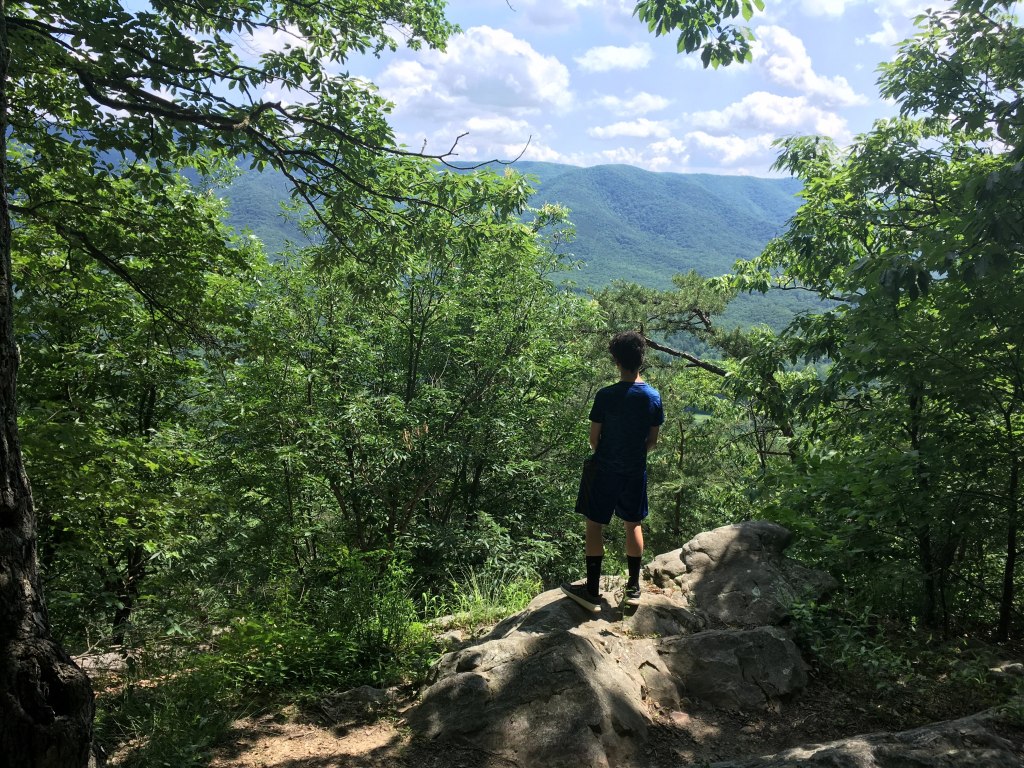
My own experience of climbing mountains has mostly consisted of beautiful hikes with my family on wide, well-worn paths in the Blue Ridge Mountains of Virginia, awarded once I’m on top by the bucolic, peaceful view in all directions.  But I think the mountain top experiences in the four stories above are the truer ones.   Maybe the mountain top is really a place to catch our breath in the middle of a challenging climb, to look around, reorient ourselves, and get a clearer vision both of where we’ve been and where we’re supposed to go next.

This past year has felt a lot like climbing a really big mountain. Within this faith family alone, we’ve literally fought fires, watched others struggle for air, experienced ground-quaking losses, and had many of our comfortable assumptions of how things are supposed to be–in church, school, community, work, and play– completely upended.  

As we approach the top of the mountain, stop, and take our breaths, different possibilities will open up before us:  

We can take a quick rest, thankful we finally made it to the top, then go back the way we came, putting this terrible climb behind us as quickly as possible.

Or we could choose to listen quietly, up here closer to the mountain top, for that still small voice of God, the one that comes most clearly after a sleepless night of panic and worry, and somehow calms our fears.  

If we take that time, maybe we’ll see someone or something we were stepping over or shoving aside on that easy, well-worn path we’ve been climbing.  

Maybe, we’ll just take some time there to feel our fear and grief, to mourn our losses, even to mutter angrily at God.

And then, maybe, we’ll be ready to take up the mantle left behind in the wake of all that, use it to make a path, and walk into the future.

So here, as we near the top of the mountain, let’s stop, take a breath, and tell some of our own stories.

  • As you look behind you, what do you see more clearly than you did a year ago? 
  • In your most exhausted moments, what have you heard the still small voice of God telling you? 
  • What has been transformed; where has light shone? 
  • And when you look down the path on the other side of the mountain, what do you see?

Full-on acknowledgment of and gratitude to Debbie Thomas and her Journey With Jesus blog post that sparked so many of the ideas in this reflection.