
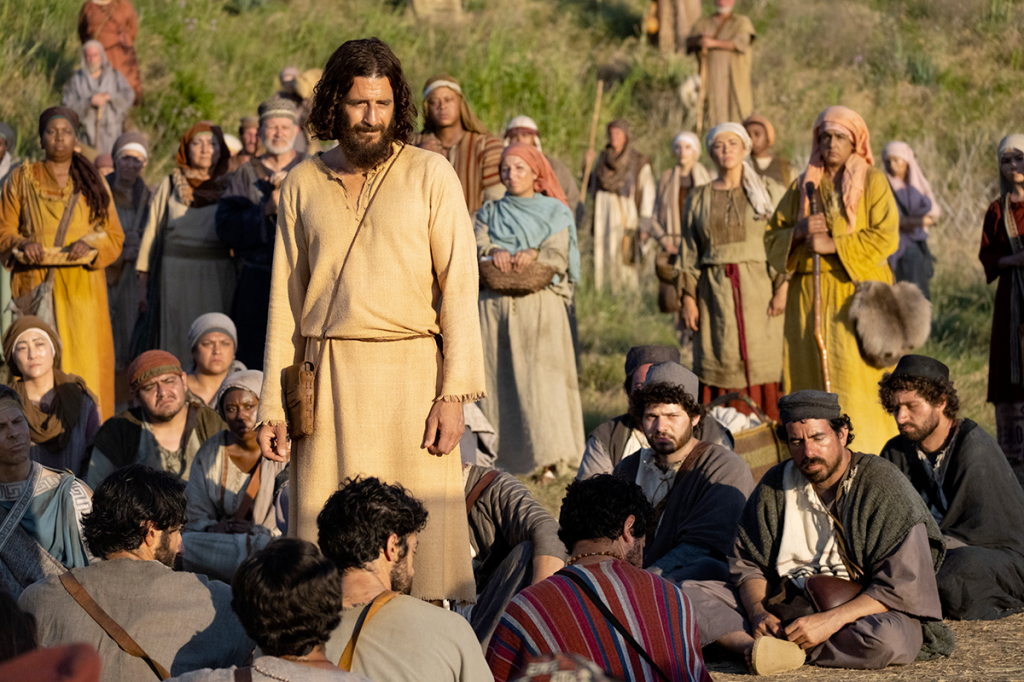
Catholic actor Jonathan Roumie stars as Jesus in a scene from an episode of the popular streaming show “The Chosen” that was filmed on location in Midlothian, Texas. News photo/courtesy The Chosen
This week, three people asked me what I thought of the television show The Chosen, a relatively unknown, crowd-sourced television series imaginatively retelling the life of Jesus.
Quick take: I love it! Watch it, pleeeeaaase, so I can talk to someone about it.
Longer take: When I first heard about The Chosen, I was skeptical. I was judgy about the director, Dallas Jenkins, because of his evangelical roots and cautious because this father, Lenny Jenkins, had co-authored the Left Behind series, books I had browsed over a decade ago looking for a good read for my oldest son and put quickly back on the shelf because of the scary Rapture-centered theme and troubling theology. Quick take: Don’t read.
An evangelical friend I love loved The Chosen, though, so I gave an episode a try, and I was hooked. I like how Jesus is portrayed in the show, full of compassion, humor, and patience. I appreciate the careful attention to setting and how different cultures are integrated into the storyline. I love the way the writers imagine the fuller lives of Jesus’ followers in ways that are realistic yet translatable to a modern understanding. For example, the tax collector Matthew is sensitively portrayed as on the autism spectrum, making me consider that disciple in a whole new way.
Until this week, though, it’s been hard for me to convince family and friends to watch the series. Most people I hang around with share the same skepticism and hesitation that I felt about jumping into a Christian television series directed by the son of a dispensationalist. To be fair, Dallas Jenkins gets his share of criticism from conservative Christians, too, most recently for defending a cameraman’s right to display a pride flag sticker on his equipment while on the set.
All this skepticism, hesitation, and protest from current followers of Jesus over a television show help me understand his exasperation in today’s Gospel. “Look,” he says to the people in the crowd who claim to know God best, “John the Baptist comes and tells you to change your ways, and you accuse him of being possessed because he doesn’t eat or drink. I eat and drink with people you don’t like, and you accuse me of being a drunk and a glutton.” Jesus is fed up with the contradictory criticisms here, but even more with the way their focus on the trivial keeps them from his ministry and his message.
Paul also describes this very human dilemma in the Letter to the Romans. The more he focuses on the heart of Jesus and the heart of the Law, he says, the more he sabotages his deepest longings: “I do not “understand my own actions. For I do not do what I want, but I do the very thing I hate.”
Ironically, some Christians interpret Paul’s words in this part of Romans in a way that I think actually recreates this problem when they use his description of the “flesh” at war with the mind to condemn others’ gender orientation or life choices. Like the religious leaders who focus on what John and Jesus put in their stomachs, their overly scrupulous focus on others’ bodies keeps them from recognizing the heart of God’s Word and Love.
Still, I don’t know what Paul is naming when he says, “The evil that I do not want is what I do.” None of us can name that for others. Something I know about myself, though, is that the more I focus on others’ wrong (to me) thinking or actions, the more I’m out of sync with the Spirit. My negative attitude toward the Jenkins family’s more conservative religious beliefs nearly caused me to miss out on a deeply thoughtful and moving portrayal of the life of Jesus. Judgment narrows my view; anger immobilizes me. One form of the evil Paul calls out in himself happens when prejudice, animosity, fear, or pride balloons into words and actions that keep us from God’s work of love and healing.
Jesus vents his frustration in today’s Gospel because pulling us out of that kind of self-righteous thinking is hard, and the smarter and the more successful folks are, the harder it becomes. The folks on the other end of self-righteous gazes often have harder lives but an easier time getting to the heart of his message, which is probably why they are among those Jesus invites into God’s love at the end of the passage. We’ll hear the traditional version in church this Sunday, but here’s a great paraphrase from The Message:
Are you tired? Worn out? Burned out on religion? Come to me. Get away with me and you’ll recover your life. I’ll show you how to take a real rest. Walk with me and work with me—watch how I do it. Learn the unforced rhythms of grace. I won’t lay anything heavy or ill-fitting on you. Keep company with me and you’ll learn to live freely and lightly.
Matthew 11:15-30
May we all learn to live more freely and lightly in the unforced rhythms of God’s grace and love.
 Sunday Morning Words