
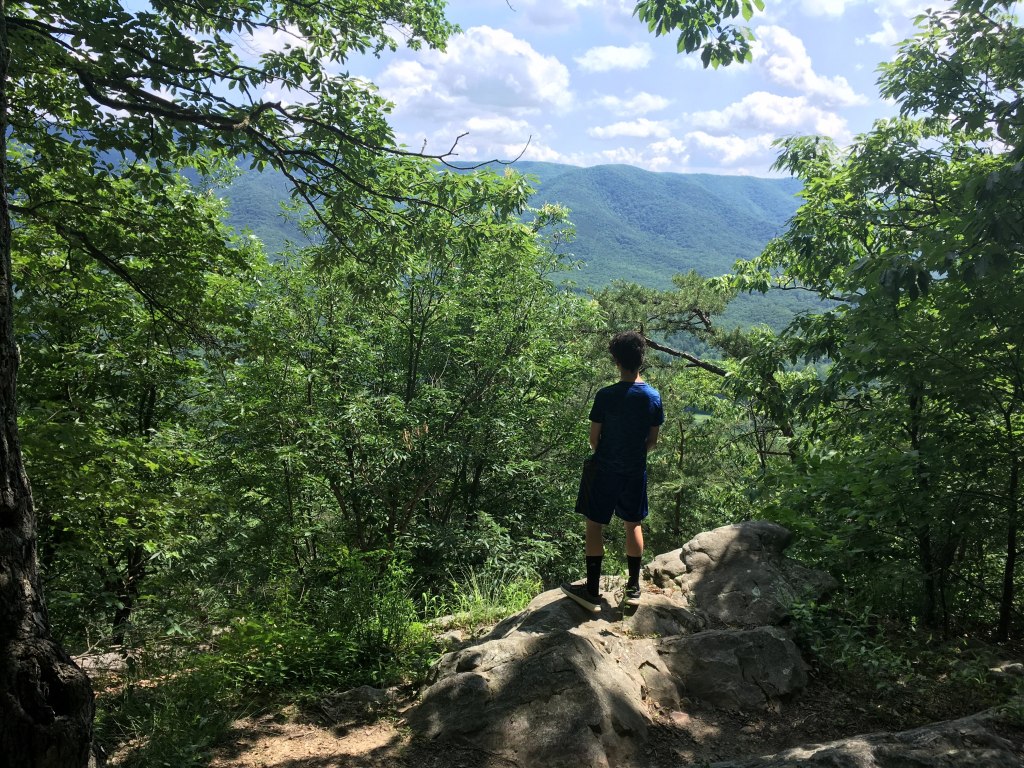
This is Transfiguration Sunday, when Jesus climbs a mountain with his closest friend and is suffused with light. Always before, as I’ve read this lesson, I’ve been caught up in the glow of that moment. This year, though, it is the mountain itself that captured me: both the climb and the view from the top. And all week, I kept seeing and hearing mountaintop stories. I’ll tell you a few of them, and as I do, see if they spark a few of your own.
The First Story
As most of you know, Mt. Everest–the world’s highest mountain above sea level, has for many decades been seen as the ultimate mountain top for experienced climbers to summit. Many spend years and many thousands of dollars to prepare for the experience. In recent years, though, thousands of inexperienced climbers have attempted the climb, backed by agencies happy to cash in on their inexperience.
In the spring of 2019, experienced climber Fatima Deryan described her experience on Everest’s summit. One hundred fifty people packed together, clipped to the same safety line. Inexperienced hikers collapsed in front of her from lack of oxygen and water.
“A lot of people were panicking, worrying about themselves — and nobody thinks about those who are collapsing,” Ms. Deryan said.
“It is a question of ethics,” she said. “We are all on oxygen. You figure out that if you help, you are going to die.”
She offered to help some of the sick people, she said, but then calculated she was beginning to endanger herself and kept going to the summit…. On the way back down, she had to fight her way again through the crowds.
“It was terrible,” she said.
https://www.nytimes.com/2019/05/26/world/asia/mount-everest-deaths.html
The Second Story
One evening at the end of January in 1956, segregationists opposing the successful Montgomery boycott threw a stick of dynamite onto the porch of the Rev. Martin Luther King while his wife, daughter, and a friend were inside. Dr. King came home 15 minutes later to find an angry, partially armed crowd of supporters gathered in front of his house, refusing police orders to disperse. Holding up his hand, he calmed them down and sent them home with these words:
“ I want you to love our enemies. Be good to them. Love them and let them know you love them….. I want it to be known the length and breadth of this land that if I am stopped, this movement will not stop. If I am stopped, our work will not stop. For what we are doing is right. What we are doing is just. And God is with us.”
Then, after a sleepless night, King had a vision that he described in a sermon one year later back in Montgomery: “Rationality left me…almost out of nowhere I heard a voice saying to me ‘Preach the Gospel, stand up for the truth, stand up for righteousness.’” Echoing the experience of Moses–who YHWH brought to the top of a mountain before he died to view the land he had led the people toward for 40 years–King told the congregation, “Since that morning I can stand up without fear…. If I had to die tomorrow morning, I would die happy, because I’ve been to the mountain top and I’ve seen the promised land, and it’s going to be here.”
The Third Story
Flashback 3000 years to Elijah, the prophet hiding for his life in a cleft on a mountain top from his enraged king and queen. While he hides, there comes a windstorm, an earthquake, and fire. And then, as he leaves his hiding place and stands on the edge of the cliff, he hears the still small voice of God, not in any of those things, but in the silence that follows.
Soon after, Elijah chooses Elisha to succeed him, and the two are so inseparable that when the time comes for Elijah to go to the Lord, Elisha refuses to accept it. He tells Elijah over and over that he’s not going to let him out of his sight, tells the other prophets warning him that the time has come to Be Quiet!, and when Elijah asks him what he can do to help, Elisha says, “Your life repeated in my life. I want to be exactly like you.” When, despite it all, Elijah departs in a flaming chariot, Elisha shouts in anguish and rips his clothing in grief. Then he takes the cloak that is all that is left him from Elijah and like his matter, strikes the water with it. Elisha, though, shouts angrily: Where IS God?” Even so, despite all his denial, grief, and anger, when the water divides for him, just as it did for Elijah before him, he walks through.
The Fourth Story
Six days before Jesus leads Peter, James, and John up the mountain top and is transfigured, he tells his disciples that the Son of Man will suffer, be tried and found guilty, be killed, and after three days rise from the dead. Peter pulls him aside to protest (bad plan, Messiah!), and Jesus turns and sees the other disciples wavering as well. “Get behind me, Satan!’ he says roughly to Peter; the path of suffering, he tells them all, is the path of life in God. Then they climb up to that mountaintop, and Jesus is lit up from inside out and talking to Elijah and Moses. In the end, they go back down the mountain and head through Galilee, slowly making their way, together, toward Jerusalem.
******
My own experience of climbing mountains has mostly consisted of beautiful hikes with my family on wide, well-worn paths in the Blue Ridge Mountains of Virginia, awarded once I’m on top by the bucolic, peaceful view in all directions. But I think the mountain top experiences in the four stories above are the truer ones. Maybe the mountain top is really a place to catch our breath in the middle of a challenging climb, to look around, reorient ourselves, and get a clearer vision both of where we’ve been and where we’re supposed to go next.
This past year has felt a lot like climbing a really big mountain. Within this faith family alone, we’ve literally fought fires, watched others struggle for air, experienced ground-quaking losses, and had many of our comfortable assumptions of how things are supposed to be–in church, school, community, work, and play– completely upended.
As we approach the top of the mountain, stop, and take our breaths, different possibilities will open up before us:
We can take a quick rest, thankful we finally made it to the top, then go back the way we came, putting this terrible climb behind us as quickly as possible.
Or we could choose to listen quietly, up here closer to the mountain top, for that still small voice of God, the one that comes most clearly after a sleepless night of panic and worry, and somehow calms our fears.
If we take that time, maybe we’ll see someone or something we were stepping over or shoving aside on that easy, well-worn path we’ve been climbing.
Maybe, we’ll just take some time there to feel our fear and grief, to mourn our losses, even to mutter angrily at God.
And then, maybe, we’ll be ready to take up the mantle left behind in the wake of all that, use it to make a path, and walk into the future.
So here, as we near the top of the mountain, let’s stop, take a breath, and tell some of our own stories.
- As you look behind you, what do you see more clearly than you did a year ago?
- In your most exhausted moments, what have you heard the still small voice of God telling you?
- What has been transformed; where has light shone?
- And when you look down the path on the other side of the mountain, what do you see?
Full-on acknowledgment of and gratitude to Debbie Thomas and her Journey With Jesus blog post that sparked so many of the ideas in this reflection.
 Sunday Morning Words