Easter 2025:  Little Bear, Baptism, and God’s Shalom

 We celebrate Jesus’ resurrection today—that tremendous, impossible-to-grasp act of love. From his baptism, Jesus is linked heart, spirit, and body to God’s shalom–God’s great love and enduring peace.  He lives out God’s kingdom here on earth in everything he says and does.  As Peter says in today’s readings, with the power of the Holy Spirit, Jesus spreads the good news throughout Judea and beyond, doing good and healing those who are oppressed by evil forces.  He does this fearlessly and doggedly until his power–God’s shalom–threatens the human powers around him so much that they murder him as publicly and brutally as possible.  And yet, his life and God’s shalom are so inextricably, mysteriously linked that he lives again, disappearing from the tomb, rising from the dead.

We can’t do that.

Isaiah, too today, writing thousands of years before Jesus, tells us of a time when God’s kingdom, God’s perfect blessing and peace, will come to God’s people, where they will all be intimately connected to God (before they call, God says, I will answer), a time when no human power can hurt or destroy.

We don’t live there. 

So, where is God’s kingdom? And to use the Godly Play question, who are we in this story?

Well, we’re not Jesus.  And I’m guessing God’s kingdom feels far away right now for most of us. But there are people in this story who can maybe show us the way.

There are the women, right?  Women going to the tomb–at great risk to their own safety–to anoint and care for their beloved Master’s body.  And when two strangers in dazzling white show up and send them to tell their friends that Jesus is not there, that he has risen from the dead, they don’t hesitate; they go back to their people, the 11 disciples and the others who love Jesus, and share that gift of incredible, impossibly good news.

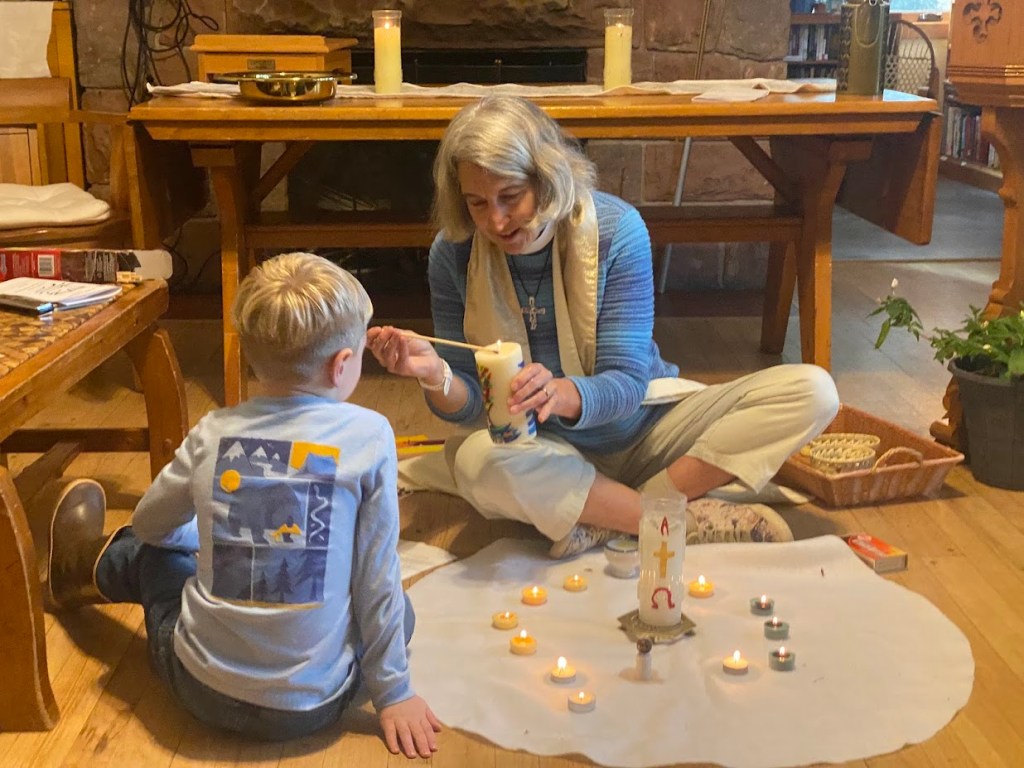
Those of you who have been around for a while know I always read a children’s book as part of my Easter reflection. As I thought about what story to read this Easter, Maurice Sendak’s A Kiss for Little Bear popped into my mind .  I thought it was because it was the book our priest, Pat, read at Phoebe’s baptism 20 years ago.  But the Spirit runs deeper than that, and when I went back to read the story, I saw those women from Luke.

Like the women, Little Bear  misses someone he loves, his Grandmother. He decides to send her a picture that he has just made that makes him happy.  And this act of caring is met with a kiss, love, shalom, that grandmother asks Hen to pass on to Little Bear.  And Hen says to Grandmother–this part matters!–”Yes, I would be happy to do that, and takes the kiss to give to Little Bear.”

When I asked A. a while back if she had any questions about baptism, she (I think brave to ask your priest this!), said, “I guess my main question is why get baptized?”  Which honestly is just such a great question, and I’m so happy to be a priest in a time where the answer isn’t “Well, because that’s just what we do.”

But it’s also a really hard question to answer, especially when that “because everybody gets baptized” response doesn’t work anymore, and I don’t think I ever got to the heart of it when she and I talked.  So I’m going to try one more time.  A., I think the reason is because when we get baptized, God gives us a blessing, a loving kiss from Grandmother, if you will, and asks us, like Hen, to pass it on.  

And then during that baptism, we take some really specific vows about how to do that, how to walk through life passing God’s shalom on to others.  But first, like Hen, we have to say yes, I’d be happy to do that—I’d be happy to be a person that passes that kiss, that love on.

Now, as Hen says, this passing on can get pretty mixed up.  As time goes by, we get distracted.  Sometimes we want to hang out with friends, sometimes we get tired, sometimes we just need to cool off for a while.  At those times, though, lucky for us, others, baptized before us, keep passing that shalom on when we don’t.  Sometimes those people are right there for us; sometimes, like Cat, they might get a little grumpy about it.  But because they also believe in the value of that loving kiss, that shalom, they carry it on.

Sometimes, too, God’s kiss, God’s great love,  gets stalled as we, like the little skunks, focus our love on a person who is especially precious to us, and it’s hard to remember to look outside that love.  And then another shalom carrier comes along to remind us to keep it going, or just carries it for us a little while until we are ready to take it up again. Because those places along the way where the kiss gets stalled can also be part of the shalom, places where we find rest and cool water, friendship, deep and abiding love for another human or three. 

This is why baptism is something we do with our whole faith community gathered here–because carrying God’s shalom needs a whole pile of people who say yes to carrying it into the world.  And when that happens, when we keep the kiss going, helping one another when needed, sooner or later–as Isaiah and Peter and Jesus and A Kiss for Little Bear all promise in different ways–we’lll find our way to a great banquet, a wedding feast fit for a king,  to which everyone—everyone!—is invited.

All because one day someone asked you if you wanted to be baptized, to carry God’s kiss, God’s shalom—and you said, yes, I’d be happy to.

The Lord is Risen!

Epiphany 3c: Singing the Way

I was raised as a Roman Catholic, a tradition I eventually left but that formed me and kept me faithful for many years. 

I’ve often credited my parents for that. My mother, supported by my dad, made sure that faith was part of our home life in concrete ways that I loved as a child and that inspired many of St. Mary’s intergenerational activities: walking Mary and Joseph toward the manger, posting our thanksgivings, laments, and prayers on the windows and walls, chalking the doors at Epiphany.

It was the music, though, that I think shaped my faith most deeply. I grew up in the seventies, the decade of folk masses and hip new hymns by the St. Louis Jesuits; we’ll sing an enduring favorite, “One Bread, One Body,” during communion this week. When I sing, words sink into my bones, and those childhood hymns embedded in me a faith centered on loving God and my neighbors. Each week, we’d sing about God’s enduring love,  presence in times of trouble, and welcome for all: Gentile or Jew, servant or free, woman or man no more in Sunday’s hymn and the body Paul describes so beautifully in the first lesson. 

I’ve spent this week reflecting on how God’s name has been used throughout this election season, including the recent  Inauguration events. Like many of you, I was moved by the way Episcopal Bishop Marion Budde humbly asked our new President to show mercy to those who were afraid at the Service of Prayer for the Nation, and I wasn’t surprised by how her words were received.  

If you, with Bishop Budde, believe deeply in the message of this week’s Gospel, that Jesus brings good news to the poor, release of captives, recovery of sight to the blind, and freedom to the oppressed; if, like Bishop Budde, you recognize that the poor, the captives, and the oppressed are real people living in our country,  whose lives are way more precarious and challenging than yours; and if you try to serve those people through your words and actions, you’re going to piss off people in power: people who often find it useful to fill us with scorn for the poor, to encourage the desire for other’s captivity in the name of safety, and to benefit financially from oppressing others.  

That scorn, that desire to shut up people who make us feel uneasy, that insatiable desire for wealth is built into the bones of every prosperous nation and every political party.   If we’re honest, we’ll find those things embedded in small ways in our own thoughts and actions most days. It’s the nature of sin–from Cain and Abel to the Crucifixion of Jesus to the Corinthians in Paul’s time to the current vilification of LBGTQ folks, migrants, and people we don’t know on social media–to hurt others for our own gain.  

But there is this other Way, a song embedded even deeper in our bones.  It sings that you and I are each God’s uniquely beloved child.  It sings that no matter where they come from or how they live, everyone else is just as beloved by God as we are.   Its verses tell us about help for the poor, release from what holds us captive, and the endless beauty of God’s will.  It sings, as we did this Sunday, that we are one body in this one Lord. This Way sings in our sinews that God’s mercy and endless compassion extend to every person and every nation (yes, even the ones who piss us off). It invites us to find a way each day to share that mercy and compassion with those who need it most, right here, where our voice, our hands, and our feet are.

The Story of Christmas: The Truths that Hold Us

For Christmas, Alex, who will be marrying Cole next summer (yay us!), gifted me three books I love and have been reading all at the same time. My favorite is My Brilliant Friend by Elena Ferrante, the first of a four-part series that takes us through the lives of two friends, Lenu and Lila, growing up in a working-class neighborhood in Naples in the wake of the World Wars.  The book’s worth it just for the way it pulls the reader into the violence, tumult, despair, and passions of that time. Still, it’s the intense, entangled friendship of the two girls that I can’t stop thinking about– particularly how the narrative that Lenu tells of Lila defines, expands, and limits her vision of herself.

Lenu is limited—even as she moves beyond Lila to middle and high school and out of Naples to college on an academic scholarship—because she sees Lila (who teaches herself much of what Lenu is learning) as her superior in mind, body, and spirit. Lila sees Lenu’s gifts more clearly but cruelly mocks her at critical parts of Lenu’s life and goes on to make a series of colossally bad choices in her own. Neither girl’s story holds all the facts, but the narratives the girls invent about each other and themselves shape the core of who they become–creating selves truer and more real than their visible accomplishments and failures.

Reading this book this season has me thinking about the Christmas story, also one of my favorites. All my life, I’ve loved everything about the narrative of Christ’s birth: angels telling everyone not to be afraid (seriously, ANGEL?); the young couple, the shepherds, and the magi heading to Bethlehem believing the impossible; and the birth in a simple dwelling, all backgrounded by the violence of the Roman empire.

Over the years, my understanding of this story has changed and grown, sometimes in ways I embraced (Mary’s Magnificat!). It also, twenty-five years ago, led to my most serious crisis of faith when I read the claim of scholars investigating the historical Jesus that there was no Census around the time when Jesus was born and that the whole journey was largely an invention of the writers of Matthew and Luke, intended to tie Jesus’s birth clearly to the events and prophets of the Hebrew Bible.

Since then, I’ve read other theologians with equally plausible arguments for the story as written. I’ve noticed, too, the way we continue to lovingly embellish the story without regard for how Matthew or Luke actually told it. There’s no donkey anywhere in the Gospels until Jesus rides a colt into Jerusalem; Matthew’s story mentions three gifts but never three kings. Still, those kings and donkeys have become indispensable parts of our creches and Christmas pageants.

And so, over the years, I’ve gradually let go of my need for certainty about what is historical event and what is parable in the Christmas story. As in My Brilliant Friend, I’ve come to understand that the narratives we create about others and ourselves are never completely factual recordings of exactly what happened. They also often contain the truth of things in a way that a listing of the facts never could.

Just as Lenu and Lila tell differing stories about their lives, the four canonical Gospels contain different stories of Jesus’s life. Mark and John, for example, ignore Jesus’s birth and childhood altogether. Each writer shares unique stories about Jesus and places similar teachings and events differently. The Gospel writers were far less interested in constructing an exact chronological history than in exploring the essential, profound mystery of how God, through Jesus, lived and acted among us.

It may be that Joseph and Mary escaped to Egypt as Herod’s soldiers slaughtered other parents’ small ones, or it may be that Matthew was remembering and recreating for his own time and place the story of the slaughter of innocent children in Egypt as the Israelites escaped over the Red Sea. It may be that Mary said the words of the Magnificat to her cousin Elizabeth; it may be that Luke revisited the song of Hannah, giving it to Mary to sing again. Either way, core truths about the great mystery of Jesus’s birth are revealed

Truths about what it means to hope when hope seems impossible. The truth that terrible suffering continues to happen in this world–suffering that is sometimes random but too often caused by powerful people careless of the lives of other human beings. Truths about the way God’s compassion and justice always bend toward those on society’s margins.

The story of Christ’s birth invites us to let go of the fear that binds us, like Lenu and Lila, to what we see as facts that are too often, instead, a lesser vision of who we are and what is possible. It invites us, like Mary, to open ourselves to the presence of the unknowable holy: to say yes when that voice one day asks us to believe that we are beloved and blessed, able to hold the impossible within the limits of our beings.

And if we say yes, the Christmas story has the power to start us on our way–with Mary and Joseph, the shepherds, and countless magi–to Bethlehem, that backwater town where a young shepherd was once tagged as king, where one thousand years later, a baby was born who grew to be the One whose story is all we need to save us from ourselves, all we need of Love.

Shine with the Light of Christ: A Post-Election Reflection

Psalm 146

Lauda, anima mea

1 Hallelujah!
Praise the Lord, O my soul! *
I will praise the Lord as long as I live;
I will sing praises to my God while I have my being.

2 Put not your trust in rulers, nor in any child of earth, *
for there is no help in them.

3 When they breathe their last, they return to earth, *
and in that day their though ts perish.

4 Happy are they who have the God of Jacob for their help! *
whose hope is in the Lord their God;

5 Who made heaven and earth, the seas, and all that is in them; *
who keeps his promise for ever;

6 Who gives justice to those who are oppressed, *
and food to those who hunger.

7 The Lord sets the prisoners free;
the Lord opens the eyes of the blind; *
the Lord lifts up those who are bowed down;

8 The Lord loves the righteous;
the Lord cares for the stranger; *
he sustains the orphan and widow,
but frustrates the way of the wicked.

9 The Lord shall reign for ever, *
your God, O Zion, throughout all generations.
Hallelujah 

Like many of you, I’m struggling to express the grief I feel about our country right now: grief over how politics have hardened our disagreements, how easy it has become to demonize the most vulnerable, how smug and dismissive we are of one another. I feel anger, too, toward those with power, affluence, and voice who profit from creating and promoting these divisions. It all makes me want to cry with the psalmist, Put not your faith in rulers or any child of the earth, for there is no help in them.

I hurt for those who worry about whether there’s enough at the end of the week to pay the rent and buy groceries to feed their children. With those who fear for the security of their marriages, friends, or neighbors. With those anxious about the precious water, earth, and air that gives all God’s creatures joy and life.

People on both sides of our country’s political divide harbor versions of these fears and more, deep in their bones.  There’s just so much we can’t control. We can’t keep hurricanes from destroying homes or solve a family member’s addiction. We can’t magically fix all the underground pain that too often lashes out in ugly words and hurtful actions. It’s a mess.

But all the stuff we can’t control doesn’t affect what we’re asked to do as the beloved children of God, who promised in baptism to carry the Creator’s light and love to others.  We are meant to wade straight into that mess, working to bring justice to the oppressed and food to the hungry.   We are called to care for the stranger, protect those whose dignity and lives are threatened, and comfort those who fear.

Just this morning, my sister sent this to our family group text (shared with her permission):  

I woke up this morning thinking about all the years of my life that I felt very marginalized and sometimes deeply hurt in our country as a queer person. It felt really crappy and very alienating to have fellow citizens passing laws that deeply impacted my humanity and to have the church of my childhood saying hateful things about me. Some of those old familiar feelings are creeping back in after this election.

One of the things that really held me through all of those years was knowing that I had the strong, unconditional love and support of my family. I know that is something people should be able to take for granted, but it’s still not something many of my LGBTQ+ friends can count on. And to think there was a time where I doubted you all would show up!

Anyway, just feeling grateful for you all as we hunker down to continue the struggle for peace and justice for everyone.

It’s part of our life as Christians to do our best (because we are fortunate enough to live in a democracy) to vote for leaders who most closely express the values and the care we desire for our families and communities.  But there has never been a time or place or government in all of history without the oppressed, lonely, and bereft.  It’s our work to identify where those marginalized, afraid, and hungry for food or justice are right now in our families and communities and then give them our concrete, unconditional love and support in whatever way they ask us.  None of that requires that the political leader of our choice gets into office, that our country is running smoothly, or that we all agree. It just requires that we live into our baptisms, loving the kingdom into being.

Shout out to St. Mary’s Sunday Night Discussion Group for shining that light last Saturday by showing up to clean Northern Light Clubhouse’s new home, readying it for folks recovering from addiction who will live there as they move out of recovery programs toward new work, new homes, and new community. Where else, beloveds, what else, who else needs God’s love and light shining through us?

Proper 8b: Beloved/Believe

Many years ago, when my boys were little and before my daughter was born, we spent a week with my family at our annual family reunion/cousin love fest.  One morning, we headed to a park on the banks of a wide river.  Two cousins wanted to cross a footbridge over to the other side of the water.  I told them I’d take them and left Cole and Sam playing with their other cousins as Drew, Amaya, and I headed to the other side, still barefooted and in our bathing suits.  We scouted around for a while, collecting colorful rocks on the shore, and then the kids pointed to people wading in the middle of the water, also picking rocks.  

“Can we go back that way?” my niece Amaya asked.  “There must be better rocks in the water.”

I looked out and saw all the way across the river that no one was in the water much over their knees, and the water was calm; I smiled and said, “Sure!” and we began wading.

I noticed a bit of current as we started across, but I figured it couldn’t be too bad with all those other people in the water.  But suddenly, about halfway across, the water deepened slightly, and the current strengthened.  The rocky bottom, too, was way more slippery than I had expected.  I looked at the other people calmly wading around us and saw–augh!–they were all wearing rubber-soled shoes.  

I looked back to the shore we’d just left, about to suggest that we head back, when both children suddenly lost their footing.  I grabbed for them, but it was too late–both started heading down the river.  It was still shallow–I could see them touching with their hands and feet, but the current was too swift for them to get back on their feet.  I watched helplessly as the water washed them further and further away from me until about 50 yards down the river they both grabbed onto protruding rocks a short way from each other and held on tight.

It was all I could do to keep myself standing, and I knew that if I tried to go after them,  even if I got to where they were, I’d never be able to get back to shore.  At that moment, I felt, for the first time in my life, my powerlessness against the force of water.  I’d feel it again a few years later at a friend’s house when Duluth was flooding and a time or two in high winds in the BWCA.  But I’ve never felt as powerless as I did at that moment;  all I could think of was the waterfall we’d passed earlier that morning downstream and how I’d face my sisters after putting their children in such danger.  

So I can empathize with the disciples in today’s readings, who thought they were doing Jesus a favor by getting him away from the crowds by crossing the lake they knew so well, suddenly facing a storm that threatened to capsize their boat while Jesus lay there fast asleep.

I looked out at Amaya and Drew, out of my reach in the water, and wondered, watching them clinging on to the rocks, not crying, not shouting for help, just waiting, still as Jesus sleeping in that boat and like the disciples wondered how they could be unafraid.  But their calm calmed me too, enough to pick my way over to the nearest person picking rocks. I pointed at the children and explained we were all barefoot: could he rescue them for me?

And, as assuredly as Jesus calmed the waters that night as the disciples watched, the man walked over to the kids, took their hands, and brought them to shore, where I joined them, and we told their confused moms what had happened.  

After the storm, Jesus asked his disciples, “Why were you afraid? Don’t you have any faith?”  

I don’t think Jesus is angry when he says these words.  Fear is natural when lives are in danger.  Of course, I was afraid when I couldn’t rescue my niece and nephew from the river’s current; of course, the disciples were fearful of drowning.  What’s more interesting is that Jesus and Amaya and Drew weren’t.

I think Jesus questions the disciples’ faith, not because of their fear, but because (in Mark) they don’t say, “Rabbi, save us, we’re drowning!”  Instead, when they wake him, they say, “Rabbi, don’t you care that we are going to drown?”

In that place of fear, they stop believing in his love, which they had seen save so many others.

Unlike the disciples, I think Amaya and Drew weren’t afraid because they never stopped believing in their belovedness. They were children sure that their parents, their Nana, their aunts, and their uncles loved them so much that they would always come to their rescue. This is probably one reason that Jesus told his followers to become more like children–because somewhere along the road to adulthood, even the most secure and happy children lose that trust that the adults who love them will always be able to save them, that their love really has no limit.

And so it is with the disciples–and my and probably your–relationship with Jesus, the one who God called beloved, the one who invites us into that all-encompassing love. We’ve seen that love in action and heard parables about its breadth and strength. And still, when we are afraid, we forget that all God asks is that we trust and lean in–that we understand that we are as beloved to God as Jesus is to the one he call Abba, as children are to the adults who love them.  We forget there is no limit or end to that love, a love that will always find a way to reach out and save us if we just hang on and believe that the One who made us, the One who has the power to calm the roughest waters, will not let us drown.  

Proper 4B: Why Sabbath Matters

Out of all the things I love about summer in Ely, I love gardening best.  I love digging into warm soil after six months of snow and watching the plants I’ve been growing for years (even the buggers I don’t want) poke up through the soil. I love the humming of bees working the apple blossoms, buzzing round me to see if I’m edible. I push my face into the lilac blossoms just off the front porch, breathing in spring.  I can’t wait to plant the vegetables I’ve been nursing for weeks alongside the heirloom tomato Steve and Nicole gift me every birthday.  I love the easy conversation with people in the neighborhood, asking how we’re doing with the deer, and digging the gardens a bit wider to make room for plants offered by strangers and friends.

If I asked you for a quick definition of Sabbath (the theme of this week’s readings), you’d probably describe it similarly to the guy in my house who just finished his final sabbatical, as rest and a time to get a break from work. That’s a good definition. In today’s first lesson, God commands the people to rest from their labors, purposefully opposing Pharoah, who responds to their requests for Sabbath by ordering them to work twice as hard making bricks for his storehouses. Fear and greed motivate pharaoh and, too often, us to normalize more and more labor to accumulate more and more stuff. In its place, God offers all we need if we choose to trust and rest.

God doesn’t describe what that rest should look like, but by Jesus’s time, the leaders of the faith had constructed many rules around what the people weren’t supposed to do on the Sabbath, something like the blue laws that kept stores closed on Sundays when I was a child. They are infuriated when Jesus deliberately breaks those rules so that his disciples can glean a bite to eat, and he can heal a man’s withered hand.  

But God’s command to observe the Sabbath was never meant to be a series of prohibitions.  That’s just substituting a priestly Don’t-do list for the Pharoah’s To-do list. The Sabbath is a time to get away from our lists and our relentless striving for more stuff, attention, wealth, and status. Sabbath, Jesus says, was created for people; it’s a time to love God and love one another. Enjoying food from the fields and healing someone’s suffering are all about that.

So, what is practicing Sabbath supposed to look like for us?  Taking time each day to breathe and pray is a kind of Sabbath, as is breaking bread together on Sunday mornings. But I also celebrate Sabbath every day of the summer in my garden as I plant seeds, re-cover the worm I just dug up, cheerfully chat with the neighbor who votes an entirely different ticket than I do, share what I grow, and nap in my hammock: all ways of loving God, loving creation, loving my neighbor, and resting from my labor.

How about you?

  • What did Sabbath mean when you were a child?
  • What does taking time for Sabbath look and feel like for you now?
  • Does your Sabbath time bring you closer to God, to creation, to your neighbor?
  • What does Sabbath (when you take it) help you resist or push against?  

Lent 2b: The Covenant and the Cross

These past two weeks, the first lessons have been about God’s covenants with Noah and, today, Abram.  God’s covenants look different in different times but are always about God lavishing blessings on people in response to their faithfulness–their saying yes to God.  

Last week, God singled out Noah as the one good person left in a world full of violence, chaos, and evil.  Sure enough, Noah listens to God and does what God asks; he builds an ark for his family and two of every animal in his backyard while his neighbors make fun of him.  Then, after the flood comes, he hangs out on the ark he built for 40 days and nights with all those animals and anxious family members, somehow keeping everyone healthy and alive.  

Then, because he did what God asked, when it’s all over, God puts a rainbow in the sky and promises never to wipe out everything and everybody again, no matter how bad things get.  Note that things start going bad again quickly once they are on dry land (though maybe not to pre-Flood levels) when Noah gets drunk and one of his sons does not respond appropriately.  You can read all about it in Genesis.

This Covenant, it seems to me, is about God realizing that people will keep acting badly—-but that no matter what, God will choose mercy and care for all living things rather than wrath and destruction.  This is significantly different from the whimsical and often cruel actions of the gods in many other religions that were around in ancient times.  

Moving forward several generation, God creates a covenant with Abraham. This time, God promises two specific things:  land and children (lots of children, as many as the stars in the sky and sands in the desert). And–this part’s important later–that through that land and those people–through Israel–God’s blessing will go out to all people.  In return, God asks Sarah and Abraham to have faith that all of that will happen and to demonstrate that faith by saying yes to going where God tells them to go.  As we heard today, they are mostly but definitely not always faithful to that covenant, but no matter what, God keeps the promises God has made.  Isaac and Ishmael both become the fathers of nations.  Abraham has lands and flocks, and his ancestors found Israel, where Jesus, many years later, is born. 

Next week we’ll hear about an entirely new covenant that God makes with Moses through the giving of the Law.

Each of these covenants is different but here’s what’s similar.  All of them are physical–God’s blessing comes in the form of long-life, physical safety, land ownership, and children.  In all of the covenants, too, people stray really quickly from the promises that they’ve made, When they do, bad things happen. Still, each time,  God remains faithful, calling the people back to their agreements, and the people return, repenting and renewing their trust in God.

Which takes us to the Covenant in the Gospel lesson today.

In Jesus, his followers are hoping for the usual solid, material fulfillment of the older covenants with God: this time that Jesus, the new David, will take the throne in Jerusalem away from the Romans and their toadies and right all the wrongs of their world.  That’s what Peter’s thinking when he (probably speaking for all the disciplesl) says, “You are the Messiah.”

But instead of political power and victory over their enemies, Jesus promises that to find new life, he will suffer and die on the cross, and they need to fall in and follow along. Can you blame Peter for taking him aside and trying to get him back to Plan A?

This time around, though, it seems like God figures there’s only one way to get at the human tendency to mess up the goodness of creation, to break every covenant we make. This time, God covenants to jump headlong into the suffering that happens every time God’s people wander away from God’s love.  

And so Jesus plunges into the worst that can happen when sin happens–and responds to that suffering with mercy and love and forgiveness right to the end. From his ride into the wrong side of Jerusalem to dying on the cross straight through to today, Jesus covenants to love and embrace us when things are messed up and people are suffering: God, loving us,  forgiving us, with us, transforming death into new life.

And all (!!)  we have to do back is say yes, Lord, we’ll do what you ask. When we see suffering? We’ll carry that cross. When we mess up? We’ll feel that weight.  When we’re the ones hurting?  We’ll let you in.