
The week before the storm, all three of our children plus two girlfriends came home. For nearly a month before that, with Phoebe at camp, Will and I had our house and gardens and projects and selves to ourselves. Having everyone together was the thing I was looking forward to and preparing for all that time–decluttering, painting, rearranging–making things comfortable and welcoming for everyone.
When they got here, it was lovely, and it was overwhelming. There were meals to plan and food to buy, a BWCA trip to get ready for, new jobs and relocations to be hashed over, and so many bodies and voices where there had been quiet and space.
So I could relate to Jesus in last week’s reading, getting everyone fed, listening to the clamor for a while, then taking off by himself to the mountain. The immediacy of the need of those around us can be exhausting, even when it’s the people we love best in all the world and want most to be with.
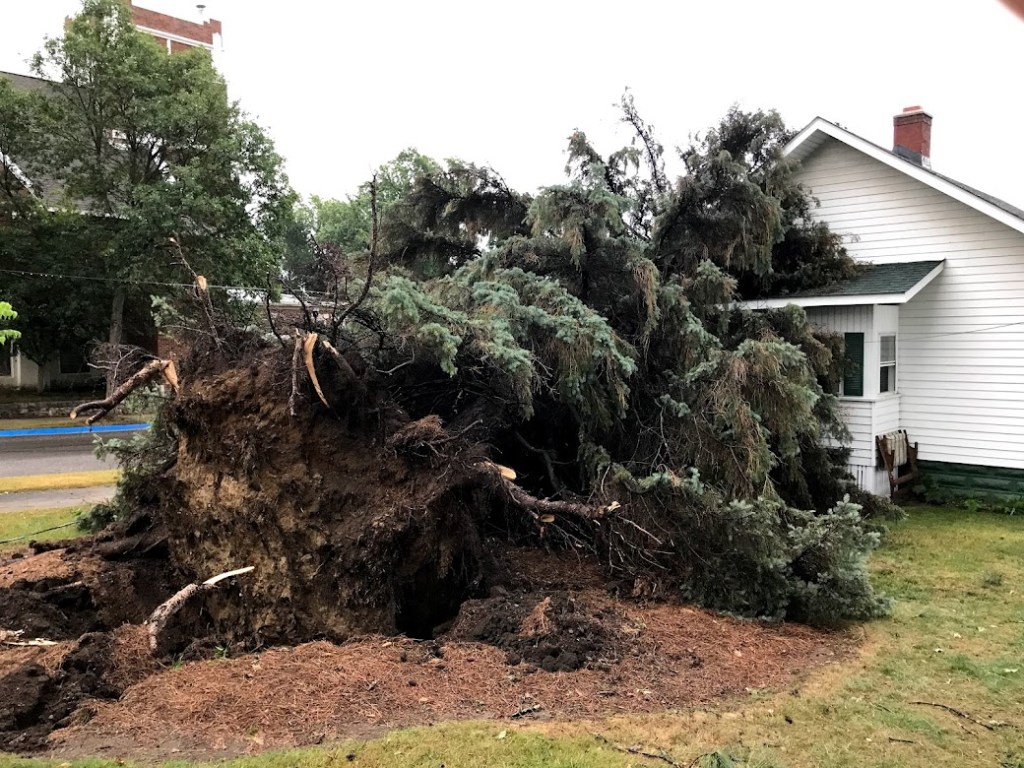
Then, later in the week, the storm with its 60 mph flat line winds hit, and the 100-year-old tree that had just that afternoon offered me a few hours of shade, privacy, and quiet fell within five minutes of a boulevard tree out front. And two of those people I loved best were in the BWCA, maybe being hit by those same winds. The fear and worry and grief were overwhelming. I switched sides, now relating to those clamoring people running after Jesus, demanding answers: Where were you? What are you going to do now? What do I do next so that nothing goes wrong? How do I know we’ll be safe?
To which Jesus says, “Just believe in me.”
Okay…but ….believe in what exactly? How do I do that? Will that solve all of this? Will I feel safe then?
Jesus wasn’t making deals with the people of his time, and he wasn’t making deals with me. No slick promises, no magically resurrecting my tree, no miraculous multiplication of burgers to feed my hungry crew, not even a radar map to show me that my kids were safe.
Instead, “I’m the bread of life. Here in front of you. All you need.”
I”m going to be honest. I’m a priest, but I don’t really understand that. What it means to have Jesus, the bread of life, here. How, exactly, believing in Jesus is going to take away all the weight and the worry.
In today’s Gospel and in the story from Exodus, the people of God are needy and anxious and not afraid to say so. They want God’s help, but when they get it–when their bellies are filled–they’re still not satisfied. They immediately start worrying about where the next meal is going to come from. This is understandable–these are folks living on the edge, barely sustaining themselves. It makes sense that they want proof that God will help them, and they want to know precisely what they need to do to get what they want. They seek control, protection against their vulnerabilities — even slavery Egypt was better than freedom in the desert, God’s people in the Exodus story believe, because at least there they knew where their food came from.
But God’s covenant with us doesn’t promise our immediate personal safety or control over the bad things that happen to us, even though the people in the desert and the people chasing Jesus across the sea, and we today, keep acting as if it should. When God feeds people and blesses them, it’s an outpouring of love, meant to be shared, not a reward to be hoarded. As a clergy friend puts it, God’s love is transformational, not transactional. Moses and Jesus both tell us: When it comes to your most fundamental nourishment, stop rooting your trust in food and leaders that can turn bad. Instead, put your trust in the God of love who cares for the whole of you.
So last week, at some point, I let go and allowed myself to believe, just enough to say, Jesus, I’m overwhelmed, and exhausted and afraid and angry right now. Please give me and these people I love what we need.
And as always happens when I pray like that, something in me–my outlook, my energy, my will–was transformed.
First, I started to see help where before I only saw loss. The first responders who came quickly and cut off the power to the downed lines in my backyard and told us how to get it restored. The electrician friend who promised to stop by and do the work as soon as we were ready. The city workers who stayed into the night to cut up the boulevard tree that had fallen. The former student of Will’s turned tree cutter who drove by in his truck, promised to be back at 7 in the morning with a crane and his chainsaw, and was. The family who stopped their truck and loaded it with a pile of branches Will was stuffing into our ancient Volvo wagon, turning a long, tedious project into ten minute’s work. The prayers and concern from all of you and from my clergy network around the state: the Body of Christ, popping up on my email, every time I looked.
Very little about the actual situation changed. It didn’t suddenly feel like everything was okay–that everyone would always be safe, that everything would immediately get taken care of. In fact, we still have a giant root ball in our backyard, a damaged roof to deal with, and contractors not returning our texts. But instead of being, as Paul puts it, “tossed to and fro and blown about by every wind,” I found myself resting in love and reassurance and kindness.
And when Cole came back from the BWCA safely, he reminded me of something else important. First, as his older brother pointed out, spending years as an Ely Boy Scout, being constantly drilled on safe camping in the wilderness, means you know what you’re doing out there. With storms brewing, Cole automatically looked for a rocky spot surrounded by low trees on his campsite and moved the tent and their canoe; he would have most likely been safe even if the winds had hit them instead of staying just south. More importantly, though, was something else Cole said to me after he got back.. The best thing about the Boundary Waters, he said, is that there’s so much you can’t control. It’s a place where you tread lightly and leave no trace. Every minute you’re out there, whether you’re canoeing through a glassy smooth lake or awake in a thunderstorm, reminds you that you’re part of something bigger than yourself.
I think that something bigger is what both Moses and Jesus are getting at today. There is something so much bigger than us and our immediate hungers and needs and lives going on with God. And at the same time, that something bigger is what keeps us steady and shows us what’s most real about ourselves.
The Message expands the translation of Jesus’ final words in today’s Gospel this way: “The person who aligns with me hungers no more and thirsts no more, ever. I have told you this explicitly because even though you have seen me in action, you don’t really believe me. Every person the Father gives me eventually comes running to me. And once that person is with me, I hold on and don’t let go.”
When we let go and align ourselves with Jesus, all our problems won’t go away. The storms will still come; there will still be lots we can’t control. But Jesus, Yahweh, the Giver of Manna, the Source of Love, the Bread of Life–is something bigger than any storm and any hunger or thirst, something–someone–that will hold on to us, draw us in to something so much greater than any of it, and won’t, ever, let us go.
 Sunday Morning Words