18 So Jesus said, ‘What is God’s kingdom like? What shall we compare it with? 19 It’s like a mustard seed that someone took and placed in his garden. It grew, and became a tree, and the birds of the sky made nests in its branches.’ 20 And again he said, ‘What shall we say God’s kingdom is like? 21 It’s like leaven that a woman took and hid in three measures of flour, until the whole thing was leavened.’
At the place in the Gospel of Luke when we hear this parable of the mustard seed, things are starting to heat up for Jesus. There’s the usual threat of Roman rulers who ruthlessly punish anyone they considered an enemy of the state. But now many religious leaders are getting riled up as well. They’re afraid of what might come their way from the Romans as more and more people start calling this guy Jesus the Messiah, the one who will restore their kingdom. And then there’s Jesus’s annoying habit of healing people on the Sabbath and otherwise just not showing a lot of respect for the way good, religious people had always done things. For all those reasons, at this point in the Gospel, they’re doing their best to discredit and get rid of him.
Also at this time, there is a huge split between the affluent folks who mostly go along with the Roman authorities and the working folk barely getting by. And so many others are living on the fringes of both of those groups, marginalized because of poverty, mental illness, and chronic disease.
People are divided. The rich are getting richer. The poor are getting poorer. The personal attacks are getting uglier.
Sound familiar?
In the midst of all of that trouble, Jesus takes a different way. Yes, speaking out strongly, angrily even, against those leaders who hold so tightly to their own power and authority that they can’t see the Spirit of God at work right in front of them.
Mostly, though, Jesus just pays attention, seeing and reaching out to the people everyone else would rather ignore. He heals them and feeds them and fills them with words of hope. But his words of hope aren’t centered on any of the stuff–the power, the wealth, the influence–that everyone is fighting over.
All of that stuff that angers and divides and fills people with fear? It just doesn’t matter to Jesus. It’s a distraction from what matters most. It keeps them–and us–from God’s kingdom.
The kingdom that is like…a mustard seed?
Mustard seeds–at least the ones in the Middle East that Jesus knew–are tiny, almost invisible to the human eye. But when they are planted, they grow rapidly–often taking only a day to send up a green sprout. In one growing season, they can grow up to 10 feet tall, with stems so thick and woody, they can be mistaken for trees.
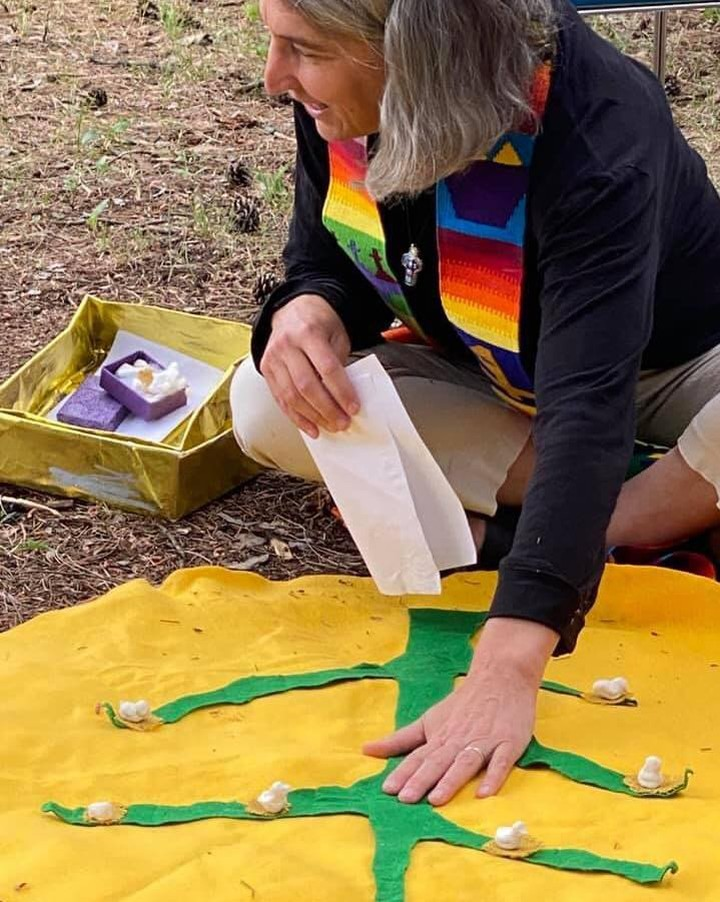
This week, I’ve spent a lot of time thinking about those mustard seeds that Jesus says are like the kingdom and wondering, as we say in Godly Play, what they could really be.
At first, I thought that the mustard seed might really be my friend who wanted to plant trees where some of our boulevard trees had been cut down and–while the rest of us worried about ordinances and City Council and public opinion–found the number of the guy who knows about planting city trees at the University of Minnesota–the director, as it happened, of their urban forestry program. That phone call grew into a grant for three truckloads of trees, a gravel bed to start them in, and folks to show us how to plant and care for them–and now, hundreds of young trees have begun to shade us as we walk and rest under their branches in our parks and by our sidewalks.
I parented three children in this town with a community of other adults supporting me and loving them. So I began to think about how the mustard seed might really be the mom or two (or four) I know who sit in one or two (or four) of our churches on Sundays. Moms who saw a child looking lost, different, on the margins, and quietly took those children into their nests and under their wings–children I’ve seen grow into strong, healthy adults who know from their cores how to love others and themselves.
The mustard seed might even be the people in four churches who used to come together once a summer on the street outside one of their buildings to share a meal together. Folks who decided one year that maybe they could leave their buildings and their differences even further behind that day to worship their God together. And that mustard tree looks just like this.
I wonder where you see those mustard seed growing?
Here’s something I think Jesus might be telling us through the parable of the mustard seed. God’s kingdom isn’t about the stuff that divides us. God’s kingdom is a thing apart from and bigger than that. Its seeds grow when we pay attention to the people and the natural world and the communities around us–especially the people and places and spaces that make us feel uncomfortable, where we prefer not to go or even look. God’s kingdom grows when we choose to take those seeds and tend them in our gardens. Jesus is telling us too, despite all the anger and violence and hopelessness that whirls around us, to never underestimate how big and strong those seeds can grow. And once we make space for them in our garden, to not underestimate how many will come–from the north, he says, the east, the west, the south—to rest in their shade and find peace.
(Video below begins with the Godly Play lesson, followed by this sermon)

 Sunday Morning Words